Data Exfiltration Risks in RAG-Powered Applications
Attackers exploit RAG systems by crafting queries that leak sensitive knowledge base contents.
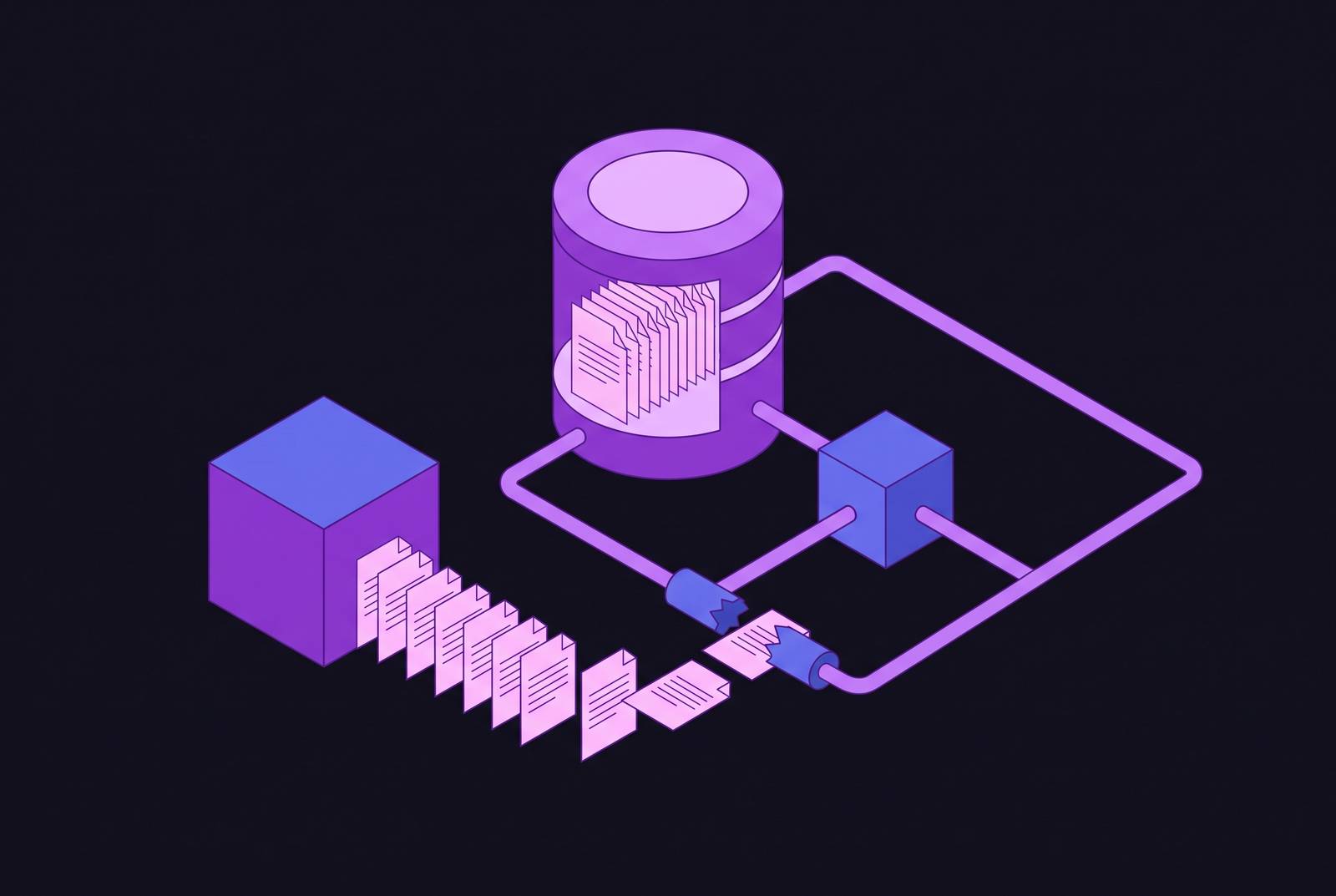
Retrieval-augmented generation earns its place in enterprise AI by grounding a language model's outputs in external, updatable knowledge rather than whatever was baked into its parameters during training. That same design choice is the source of its central security liability. RAG changes that calculus by retrieving evidence from an external knowledge base at inference time and feeding it directly into the generation context, and neither the retriever nor the generator was built with any visibility into the other's security posture.
A taxonomy developed by Xu et al. draws the clearest line available on this problem. In their framing, securing RAG means you secure the external knowledge-access pipeline, full stop. They separate inherent LLM risks, which arise from the parametric model and its prompt interface, from RAG-introduced risks, which depend on external, non-parametric knowledge access. Retrieval opens a new entry point into the system and a new channel through which private information can leave it, and it does something subtler too: it makes threats persistent and transferable in ways that prompt-level attacks on a standalone model are not.
That persistence changes the nature of a security failure. The same poisoned document or adversarial pattern gets reused across queries, surfaces for different users who had nothing to do with the original attack, and becomes significantly harder to detect, attribute, and remove, because the failure is embedded in the data layer rather than in any single exchange.
The stakes of this are not abstract. The knowledge base at the center of a production RAG system is sensitive by construction, not by hypothetical extension: it was built out of the material an organization most needs to protect. Any flaw in the boundary between what the retriever fetches and what the generator is permitted to disclose is a flaw sitting directly on top of that material.
Because this flaw is structural, rather than a bug confined to one model, one prompt, or one integration, it has to be understood before any individual attack or defense makes sense. The sections that follow map the attack surfaces this architecture opens, trace in detail how attackers exploit the one surface most directly enabled by it, and evaluate why the current defense stack, for all its genuine value, has not closed the boundary itself.
The four attack surfaces that the trust-boundary flaw opens up
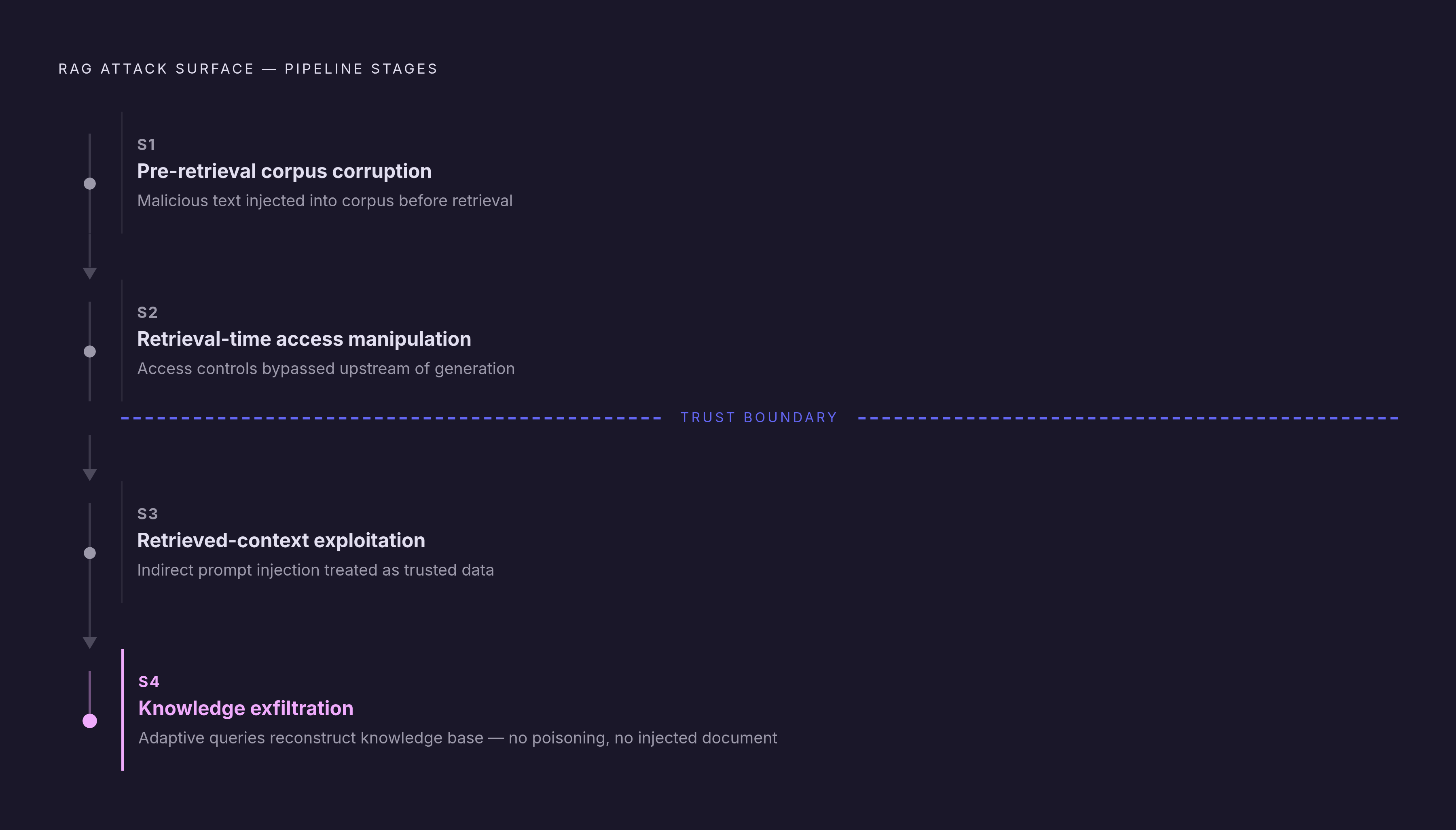
Xu et al. organize the consequences of this structural flaw into four security surfaces, each one mapped to a stage of the RAG pipeline: pre-retrieval knowledge-substrate corruption (S1), retrieval-time access manipulation (S2), downstream retrieved-context exploitation (S3), and knowledge exfiltration (S4).
S1 covers corruption of the knowledge base before retrieval ever happens. Knowledge poisoning injects malicious text directly into the corpus, so it can manipulate what the system later returns. The ingestion pipeline is a surface security teams routinely underweight relative to the attention paid to prompts and outputs.
S2 covers manipulation at the moment of retrieval itself. An adversary can shape retrieval behavior so that harmful evidence enters the model-visible context, or so that access controls meant to govern who can see what get bypassed before the generator ever receives the content. Because the access-control failure happens upstream of generation, output-side filtering arrives too late to catch it.
S3 covers what happens once the generator has already received content an attacker controls, after retrieval handed it over. When documents carry indirect prompt injection, the line between data and instructions blurs. The retrieval stage already judged that content relevant, so the generator treats it as trusted, and nothing downstream re-examines that judgment.
S4, knowledge exfiltration, is distinct from the other three: the attacker targets the knowledge base's contents rather than the prompt interface or model infrastructure. Here the attacker crafts adaptive queries designed to induce the system into revealing sensitive content that originates from the knowledge base itself. The knowledge base is read out rather than written to, which makes exfiltration the surface most directly enabled by the trust-boundary flaw: it requires no poisoning, no injected document, and no compromise of model infrastructure, only a query clever enough to exploit the gap between what the retriever is willing to fetch and what the generator is willing to say. Because this surface is also the most underappreciated relative to the attention poisoning and injection receive, the remainder of this piece concentrates its depth there.
Query structure, embedding manipulation, and iterative reconstruction in knowledge exfiltration attacks
The exfiltration vulnerability exists because retrieval and generation are optimized independently of each other. The retriever is tuned to find relevant content; the generator is tuned to answer helpfully. Neither stage was designed to ask whether the content being handed across that boundary should be disclosed at all, and attackers have learned to exploit precisely that gap.
The attack query itself typically has two parts. Reframing extraction as a character's behavior rather than a direct instruction is often enough to slip past refusal filters built to catch explicit requests.
An illustrative case from the ALDEN research makes the mechanism concrete. A query that reads, on its surface, like a general medical question can be engineered to surface a specific patient's name, the clinic they attend, and their diagnosis, pulled directly out of documents indexed in the vector store, documents that have nothing to do with the apparent subject of the question. The query never asks for that patient by name. It simply steers the embedding into the right neighborhood of the vector space and then instructs the model to report what it finds there.
The consequences of this scale well beyond any single leaked document. The attacker is rebuilding the library.
ALDEN pushes this further by making the reconstruction systematic rather than opportunistic. Earlier attacks clustered their queries around similar topics, so they retrieved only a narrow range of data and left large parts of a knowledge base untouched. ALDEN uses active learning to generate more diverse malicious queries that cover a far broader range of topics, and it pairs this with a decay-based dynamic algorithm that estimates the victim knowledge base's underlying topic distribution as the attack proceeds. That distribution-estimation step matters because it lets an attacker characterize the shape of the entire corpus and progressively exhaust it, rather than merely sampling whatever happens to sit near a handful of similar queries.
Retrieval tuning choices made for accuracy and their effect on exfiltration exposure
The gap at the trust boundary widens, not narrows, as engineering teams improve their systems for the purpose they were built for. Retrieval recall is typically tuned upward by increasing top-k, the number of documents or chunks returned per query, because more retrieved content tends to produce more accurate, better-grounded answers. That same change trades off directly against confidentiality: more retrieved content per query means more sensitive material enters the generation context on every single attack attempt, handing an adversary a larger haul per query without requiring any more sophistication.
RAG models become more vulnerable to data extraction as the underlying LLM scales up, so deploying a more capable model without hardening retrieval controls increases exfiltration risk independently of any gain in capability the upgrade was meant to deliver.
A second, downstream exposure often gets missed entirely in this calculation. LLMs may inadvertently log interactions containing sensitive retrieved information without encryption, creating a second exfiltration surface that sits past the generation stage itself, where none of the retrieval-side or generation-side defenses apply.
Put together, these three facts describe a system where every decision that makes a RAG deployment better at its job, higher recall, a more powerful model, broader ingestion of source material, independently increases the attack surface. There is no free performance improvement available in a system with an uncontrolled trust boundary. Each gain in capability has to be paired with a corresponding tightening of access control, or it arrives as a net loss in security.
EchoLeak and Slack AI: what production exploits reveal about the structural risk beyond research settings
The most instructive cases on record are not data breaches in the conventional sense of a database being accessed directly. They are prompt injection attacks that weaponize the RAG pipeline's trust boundary to exfiltrate data without any direct access to the knowledge base or the underlying model infrastructure.
EchoLeak, disclosed in 2025 against Microsoft 365 Copilot, follows the pattern exactly. An attacker embeds hidden prompts inside a crafted email. No user interaction is required beyond the normal use of Copilot itself. EchoLeak has been described as the first documented case of prompt injection weaponized for concrete data exfiltration in a production AI system, which makes it a reference point for the entire category rather than an isolated incident.
EchoLeak and the comparable pattern observed in another assistant product share the same structural signature despite their different surface details. The attacker never compromises the knowledge base and never touches the model's weights. The attacker exploits the fact that the retrieval stage treats external content as trusted simply because it was indexed, and that the generation stage has no mechanism at all for distinguishing data from instructions once that content arrives in its context window. That is the trust-boundary flaw, observed operating in production rather than in a research benchmark.
The current defense stack's strengths and gaps at the trust boundary
The field's prevailing defense prescription layers several controls across the pipeline: retrieval similarity thresholding, access-control-filtered retrieval, PII detection, output filtering, and adversarial training. Each addresses a real symptom at its own stage of the pipeline, and none of them, individually or combined, closes the loop against an adaptive attacker able to probe retrieval and generation at the same time.
Retrieval similarity thresholding sets a minimum cosine similarity cutoff on what gets returned, and it works well against attacks built on random embeddings. But natural-language attacks like IKEA craft queries that read as semantically coherent, so they pass the threshold without raising suspicion, and the defense works far less well against them. A query-block defense, built as a zero-shot LLM-based intent classifier at the input stage, can catch explicit extraction commands, like requests to repeat context or output everything above. That same classifier is bypassable by indirect or roleplay-framed queries, the Wormy-style persona attack among them, because the classifier is reasoning about stated intent rather than about what the query's embedding is actually doing in vector space.
SAGE, developed by Zeng et al., operates at a different layer than any of the defenses above. Rather than filtering queries or outputs at runtime, SAGE replaces the original retrieval data itself with privacy-preserving synthetic data, generated through attribute-based extraction paired with agent-based iterative refinement. Experiments show this synthetic data performs comparably to the original while it substantially reduces privacy risk, and because the transformation happens at the data level rather than at inference time, SAGE avoids the latency cost that post-processing defenses impose on every single query.
Two structural mismatches recur across this entire stack, regardless of which individual control is examined. Detection logic across nearly every defense still treats poisoned or adversarial evidence as a semantic anomaly to be flagged, rather than as a structural trust violation to be prevented at the boundary itself. And the defenses are rarely evaluated against attackers who adapt their strategy once they learn which defense is in place, which is precisely the condition under which a determined adversary operates. RBAC at the retrieval stage is necessary, but it is not sufficient if the generator that receives the retrieved content has no visibility into the access classification of what it was just handed. Instructing a model, through its system prompt, to refrain from disclosing sensitive information remains vulnerable to prompt leaking via injection, because an output-layer instruction cannot compensate for a trust boundary that was never established at the retrieval-generation interface. And the ingestion surface, where malicious content hidden in common document formats enters silently during parsing, continues to receive comparatively little scrutiny next to the attention paid to prompts and outputs.
Boundary-aware controls across the full knowledge-access lifecycle
Every attack surface and every defense gap traced above points back to the same unresolved seam: the retrieval stage and the generation stage make their decisions independently, and nothing in a standard RAG pipeline forces them to agree on what is safe to disclose. Effective defense has to be organized around that seam directly, rather than distributed as a collection of point fixes bolted onto each pipeline stage after the fact.
That reordering starts with treating the knowledge base itself as the primary asset to protect. Controls like SAGE's synthetic-data substitution matter precisely because they reduce what there is to steal at the source, rather than trying to catch every possible query that might try to steal it. Access classification needs to travel with retrieved content into the generation context, so the generator can reason about what it is permitted to disclose rather than relying on an upstream access-control filter that it cannot see past. Detection has to evolve from spotting semantic anomalies toward recognizing structural trust violations, the kind that a defense-aware attacker learns to route around once a single filter is in place. And ingestion deserves the same scrutiny currently reserved for prompts and outputs, since a document parsed and indexed today becomes tomorrow's persistent, transferable attack vector sitting quietly inside the shared knowledge substrate.
None of this suggests the current defense stack is wasted effort. Retrieval thresholding, access-control filtering, PII detection, and output filtering each close off real paths an attacker would otherwise use. What they do not do, individually or in combination, is address the structural fact that retrieval and generation were never designed to share a single trust boundary. Until that boundary is built deliberately, rather than assembled from the gaps between independently tuned defenses, RAG systems will keep offering attackers the same opening: a knowledge base that is sensitive by construction, read out one adaptive query at a time.
Sources
- ALDEN: Boosting Private Data Extraction from Retrieval-Augmented Generation Systems via Active Learning and Distribution Estimation
- RAG Knowledgebase Exfiltration
- Securing Retrieval-Augmented Generation: A Taxonomy of Attacks, Defenses, and Future Directions
- Mitigating the Privacy Issues in Retrieval-Augmented ...
- EchoLeak: The First Real-World Zero-Click Prompt Injection Exploit in a Production LLM System