MCP, Explained Without the Hype
A vendor-neutral standard that lets AI models connect to any tool without custom code.
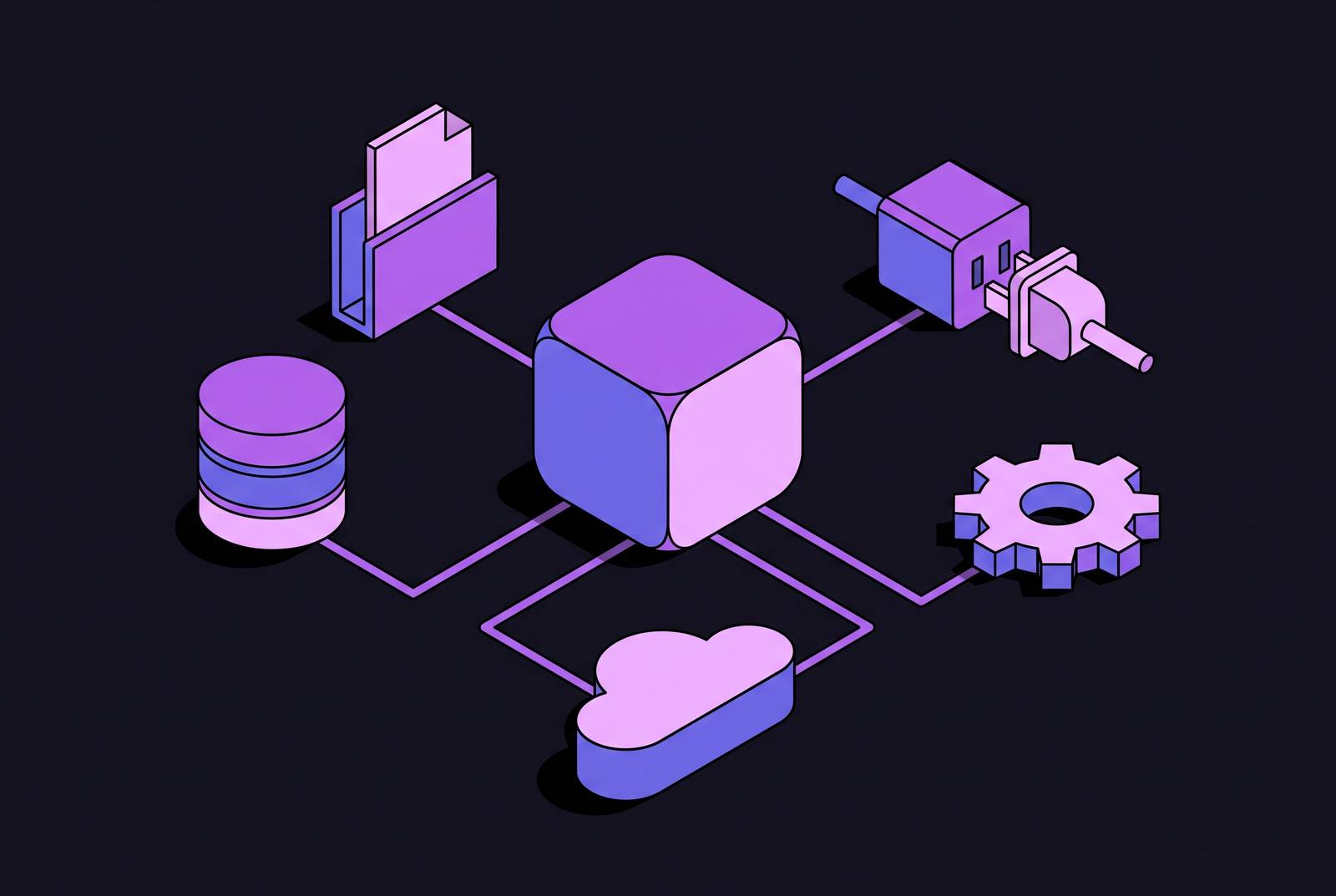
MCP stands for Model Context Protocol, and it solves one specific headache: it gives AI models a single standard way to connect to outside tools and data, instead of forcing engineers to hand-build a new connector for every model-tool pairing. That sounds small. It isn't. Before MCP, hooking an AI model up to a database, a code repo, or a CRM meant building a custom bridge from scratch, and swapping out either side meant tearing it down and starting over.
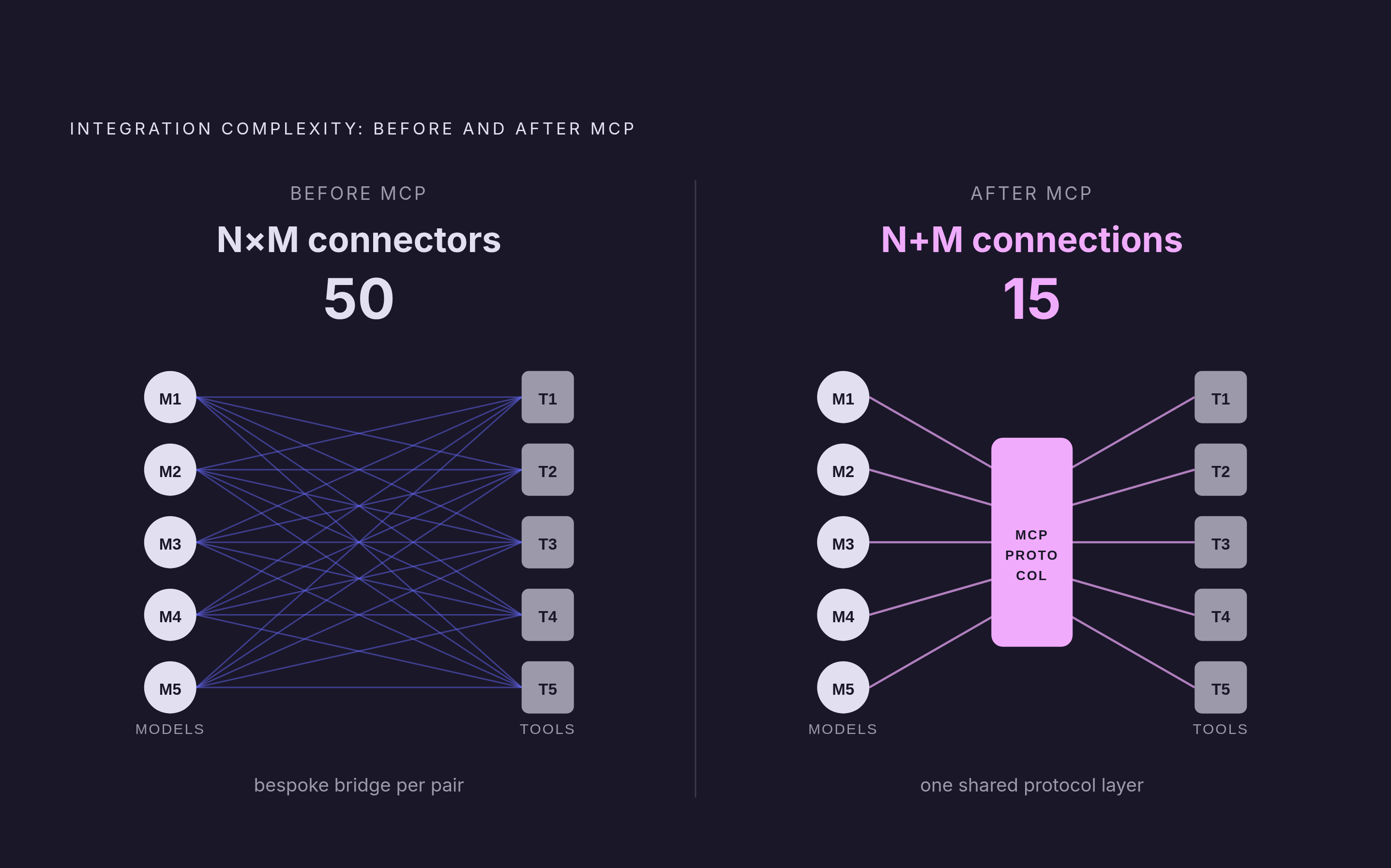
Anthropic, the company that published the spec in November 2024, called this the N×M integration problem: N models, M tools, and the number of one-off connectors needed grows into something nobody wants to maintain. Earlier fixes, like OpenAI's 2023 function-calling API or the ChatGPT plugin framework, chipped away at pieces of this, but they stayed vendor-specific. A plugin built for one platform never traveled to another. Think of the pre-USB-C phone drawer: every device had its own charger, and switching phones meant buying a new cable. MCP standardizes the port itself, and leaves whatever plugs into it unstandardized.
What MCP actually is, in plain terms
MCP is an open standard. It belongs to no single product or model. Anthropic published it in November 2024, and the Agentic AI Foundation, under the Linux Foundation, now decides where it goes next, so no one company steers its direction anymore. Picture a single port that works no matter who built the device plugging into it: that's the whole idea. A shared language any AI model and any outside tool can use to talk to each other.
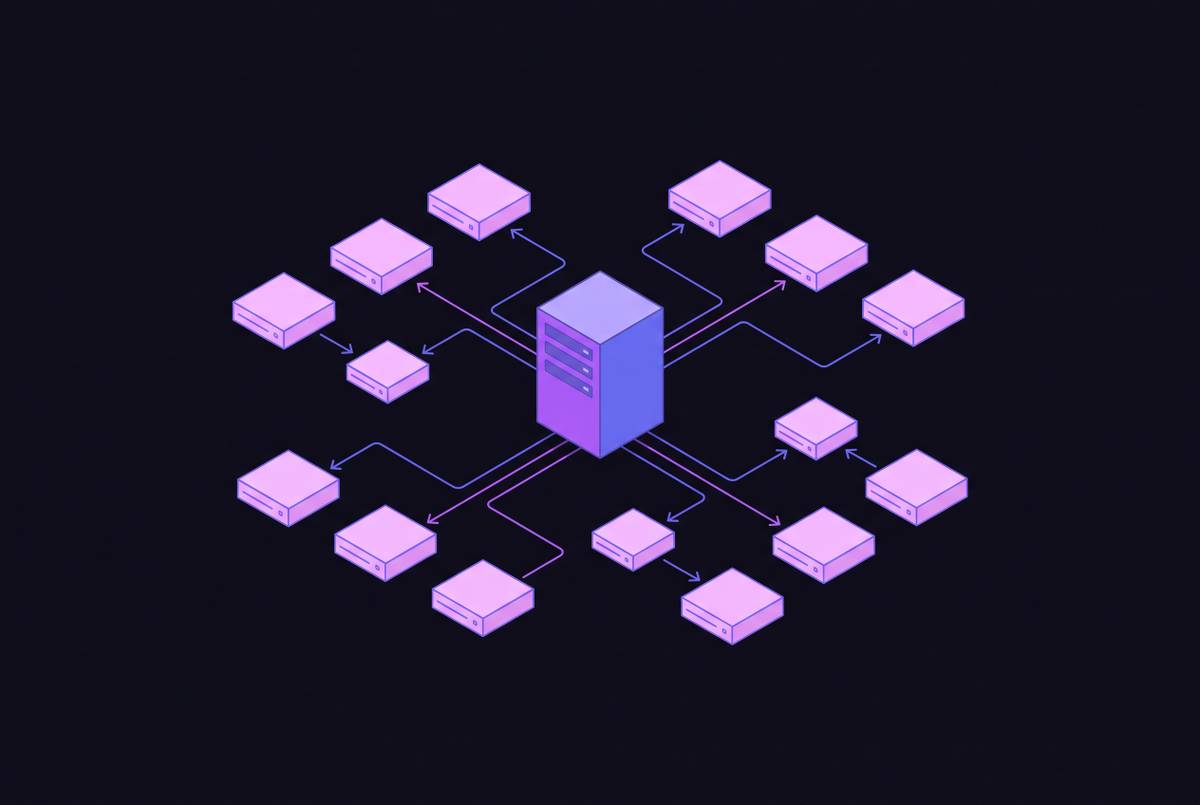
Here's how it actually works underneath. An AI model, called the "client" in the spec, asks a connected server one question: what can you do? The server answers in plain, structured terms, laying out its tools and how to call them. The model then uses those tools directly, with no glue code written just for that pairing. That's what turns N×M into N+M: build one server per tool, one client per model, and any combination just works, no custom bridge required.
Two engineers at Anthropic, David Soria Parra and Justin Spahr-Summers, built MCP, borrowing its message-passing structure from the Language Server Protocol, the standard that already let editors like VS Code talk to any programming language's tools without custom work for each pairing. MCP runs on JSON-RPC 2.0 underneath, but the detail worth keeping is simpler than that: the format is open, owned by no one, free to use without licensing it or reverse-engineering anything.
The three moving parts: host, client, server
MCP breaks down into three roles. The host is the AI application a person is actually using, whether that's Claude Desktop, a coding assistant, or some enterprise agent built in-house. The client lives inside the host and handles the technical back-and-forth, one client per server connection. The server is a small service wrapping a specific tool, a database, a file system, some SaaS platform, and it exposes what that tool can do in MCP's standard format.
Trace how a request actually moves. A user asks the AI something that needs outside data. The host figures out which server can answer it and tells its client to connect. The client asks the server what it offers, the server describes its capabilities back, and the client calls the right tool. The server runs it, sends results back, and the host folds those results into the conversation. The user just sees a sharper answer. No visible plumbing.
Servers can run locally on the same machine or sit remotely somewhere else, though clients and hosts almost always run paired together. A spec revision on July 28, 2026, made the protocol layer fully stateless: every request now carries everything it needs on its own, with no session to set up or keep alive between calls. David Soria Parra called it the most substantial change to the protocol since authorization was added, and in practice, it made remote MCP servers much simpler to deploy and scale.
How fast this went from niche spec to infrastructure
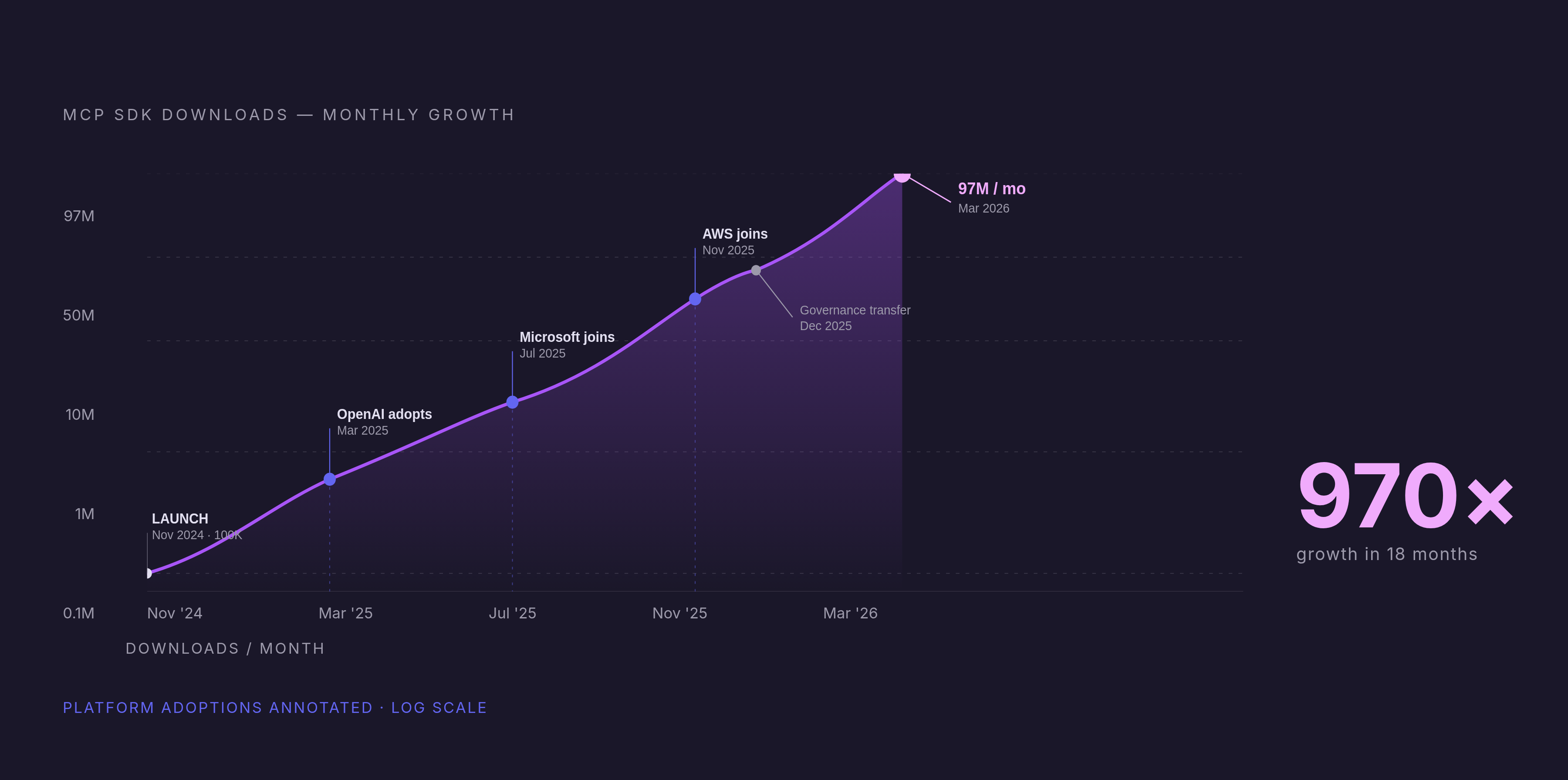
One number tells most of the story. SDK downloads sat around 100,000 a month when MCP launched in November 2024. By March 2026, that figure had climbed past 97 million a month, a jump of roughly 970 times in eighteen months. A jump like that doesn't happen because a spec is clever. It happens because the platforms everyone already uses decided to get behind it.
And they did, one after another, fast. OpenAI adopted MCP across its products, including the ChatGPT desktop app, in March 2025. Microsoft followed in July, AWS in November. By September 2025, OpenAI had added MCP support to ChatGPT, enabling third-party access through its apps. The broader "Apps in ChatGPT" feature, letting third-party apps run inside ChatGPT itself, launched at DevDay that October.
Then, in December 2025, Anthropic handed MCP over to the Agentic AI Foundation under the Linux Foundation, with Anthropic, Block, and OpenAI as co-founders. Google, Microsoft, AWS, Cloudflare, Anthropic, Block, Bloomberg, and OpenAI signed on as platinum members, and more than 150 founding member organizations joined at launch, marking a significant expansion of the open governance ecosystem. That governance shift matters more than it sounds like it should: once no single vendor controls the spec, enterprise buyers stop worrying that building on MCP means betting on one company's roadmap.
By mid-2026, more than 10,000 MCP servers were running in production, with community-tracked directories counting somewhere between 8,000 and 12,000 distinct servers, up from around 50 at launch. That April, the Agentic AI Foundation held the MCP Dev Summit North America in New York City, pulling in roughly 1,200 attendees, proof this had become a conference-scale ecosystem and not just a GitHub repo people watched from a distance. Salesforce announced its Headless 360 platform that same month, exposing its capabilities through MCP tools, with the Headless 360 MCP Server hitting Beta in July. By late May, Salesforce reported 4.5 million MCP calls processed since launch.
What enterprises are actually using MCP for today
Three patterns keep showing up inside enterprise deployments, and the internal-data server is the one worth paying attention to. Companies expose internal data lakes, knowledge bases, and ticketing systems to employee-facing AI assistants, turning data that used to sit locked in a database into something an agent can query on request. This is the highest-leverage use of MCP right now, because it doesn't ask a company to change its tools, only to open a door into them.
The second pattern is vendor-published servers. Snowflake, Databricks, Salesforce, ServiceNow, Atlassian, and GitHub all ship their own MCP servers now, so customers connect an AI agent straight into those platforms without writing a custom bridge for each one. Guideline, a company that builds Ad Intelligence and Media Plan Management technology, launched its own Media Plan Management MCP Server in March 2026, letting advertising agencies and media buyers connect their AI agents directly into Guideline's platform. That server fixes a specific headache: agencies manually exporting data and stitching together reports across systems that never talked to each other.
The third pattern, the MCP gateway or proxy setup, is really a security answer wearing an architecture costume. A company runs a gateway that handles authentication, logs activity, and enforces policy between AI clients and the servers they're talking to, giving compliance teams one choke point to watch instead of dozens of scattered connections. It's less exciting than the other two patterns, but it's the one that gets a deployment past a security review, and skipping it is usually the reason a promising pilot never makes it to production.
The before-and-after pattern is consistent across agency deployments. Before MCP, teams built one-off AI workflows in isolation, rebuilding the same credential setup repeatedly because nothing was shared. After a structured MCP rollout, that reinvention stops and time-to-deliverable drops. A quieter argument sits underneath all this: because MCP is vendor-neutral, a company can swap which AI model it runs without rewriting every integration built on top of it. With the leading frontier model changing every few months, that portability is essential. It's the whole point of building this way in the first place.
Why MCP is showing up inside AI visibility and brand monitoring tools
Buyers now research vendors inside ChatGPT, Google AI Overviews, and Perplexity before they type anything into a traditional search engine. Gartner predicted traditional search engine volume would drop 25% by 2026, a trajectory that click and traffic data from the same period continues to support.
Click-through data backs it up. Ahrefs looked at 300,000 keywords and found that where AI Overviews appear, click-through rates for the page ranking first drop by as much as 58%, from 7.3% down to 1.6%. Showing up inside the AI's answer now matters more, commercially, than holding the top organic spot.
A deeper wrinkle sits underneath that shift. Research into AI search citations found that about 85% of brand mentions inside AI search answers come from third-party pages rather than the brand's own site. A brand is 6.5 times more likely to get cited through some other source, a review site, a forum thread, a news article, than through anything it owns directly. And the overlap between what ranks well in AI answers and what ranks well in traditional search is thin: a study by Louise Linehan and Xibeijia Guan, running 15,000 prompts through Ahrefs Brand Radar, found only 12% overlap between AI citations and Google's top 10 results overall, and ChatGPT alone came in at just 8%. Ranking first on Google tells a brand almost nothing about whether an AI model will cite it.
That gap is exactly why MCP has started showing up inside AI visibility and brand monitoring platforms. These tools track where and how a brand gets mentioned across AI answers, and MCP lets them plug those monitoring dashboards straight into the CMS tools, project trackers, and communication apps where marketing teams already do their work, so a team can act on a visibility insight without switching context. Profound's External MCP Connectors work this way, linking CMS tools, project trackers, and team chat apps to Profound over MCP so an agent can act on visibility data right inside the systems a team already uses. Profound also built a feature called FactCheck, described as the first way for brands to check AI accuracy at scale: it measures what AI engines are actually claiming about a brand, where those claims go wrong, and which sources are feeding the errors.
The practitioner logic is straightforward: having visibility and competitor data reachable by other tools, instead of locked inside a dashboard, is what makes these platforms genuinely useful day to day. AI visibility monitoring is turning into a brand-management function now, one that reaches well past whatever an SEO team's dashboard used to cover.
How agencies are managing AI visibility across client portfolios using MCP-connected tools
Most AI visibility tools get built and priced for a single brand watching its own footprint. Agencies need something else entirely: dashboards holding multiple clients at once, reporting that can carry the agency's own branding, and pricing that doesn't punish an agency every time it onboards a new account. Buying a single-brand tool and trying to stretch it across twenty client accounts is the mistake most agencies still make, and it shows up fast in billing chaos and reports that look nothing like the agency's own brand.
Clients are already asking the harder question out loud: why does a competitor show up inside an AI answer and we don't? Agencies that can answer with tracked data keep the account. Agencies that can't, lose the conversation, and often lose the client right along with it.
GEO, or Generative Engine Optimization, runs roughly 80% strategic and 20% technical. Positioning, ecosystem presence, and brand authority matter more than any single technical fix, and agencies that grasp that split can lead a client's strategy instead of executing tasks handed down from somewhere else. But that only holds if the agency's own account team can speak to it with real confidence. An account manager who can't explain why AI citation rankings and SEO rankings diverge, or what actually moves visibility inside an AI answer, can't sell the service, and can't defend it when a client pushes back. Enablement is required here. It's the prerequisite, and skipping it is why some agencies buy the right tool and still lose the account six months later.
A handful of MCP-connected tools are worth naming for agencies working this space in 2026. SEOforGPT stands out as one of the stronger MCP options for tracking AI visibility. Finseo runs seven read-only tools that return live brand visibility, competitor rankings, cited sources, tracked prompts, and AI query fan-outs across major AI platforms. SE Ranking, Frase, and Conductor all offer solid protocol-based visibility tracking too, and an open-source Visibility server exists for teams that want a community-built option instead of a commercial one.
Some platforms take a different approach, built specifically for agencies managing several brands rather than one. These give account teams a single workspace across an entire client portfolio, with cumulative analytics spanning all clients at once, fine-grained control over which clients get access to which parts of the platform, and billing that runs centralized or per-client depending on how the agency structures its own contracts. It also generates bespoke weekly reports and per-client data exports an agency can hand straight to a client as proof of value, and dedicated enablement support helps sales reps and account managers speak to AI visibility with actual confidence, rather than reading off a dashboard they don't fully understand.
That last piece is the one worth sitting with. An account team that can explain what MCP is, why AI citation rankings don't track SEO rankings, and what actually shifts a brand's visibility inside an AI answer, occupies a different position with a client than a team that's just handing over a login to some platform. Understanding MCP as plumbing is a fine start. Understanding how that plumbing now runs straight into brand monitoring and client reporting is what turns the knowledge into something an agency can actually charge for in 2026.
Sources
- Model Context Protocol (MCP) explained: A practical technical overview for developers and architects
- Model Context Protocol - Wikipedia
- What is the Model Context Protocol (MCP)? | deepset Blog
- What is Model Context Protocol (MCP)? | IBM
- What Is MCP? A Simple Guide to Model Context Protocol for Salesforce Admins - Salesforce Admins
- prnewswire.com
- Model Context Protocol (MCP) explained: An FAQ
- One Year of MCP: November 2025 Spec Release