Audit Logging Requirements for Regulated AI Deployments
Regulators now demand complete audit trails for AI systems, with material penalties for failure.
Three regulatory events in 2026 turned AI audit trails from a best practice into a legal obligation, and now the penalties for failure can be material. On February 23, 2026, COSO published "Achieving Effective Internal Control Over Generative AI," specifying that effective monitoring requires a complete audit trail capturing prompts, inputs, outputs, model and configuration versions, and evidence of human review, enough to reconstruct what the AI acted on and to show the control functioned as designed. On March 19, 2026, the SEC announced a dedicated SOX enforcement group targeting audit firm misconduct, signaling heightened scrutiny of firm-level quality controls and lower tolerance for failures in internal control over financial reporting, with AI-touched controls squarely in scope. Audit logging works as traceability-as-accountability: it converts an AI decision from a black box into a documented, challengeable record, and without it, an organization cannot prove a model behaved correctly, fairly, or within its authorized scope at any given moment. That standard separates AI audit logging from general application logging. The sections that follow map where that architecture falls short and what has to replace it.
The three overlapping layers of AI regulation
AI regulation is not a single statute you can read once and file away. The first layer is foundational data privacy law: GDPR, HIPAA, CCPA, and their equivalents predate generative AI but apply to it in full. The second layer is AI-specific legislation: the EU AI Act, U.S. state AI laws, and the NIST AI Risk Management Framework impose obligations beyond data privacy, including risk assessments for high-risk systems, transparency and logging requirements, and human oversight mandates. The third layer is sector-specific: CMMC for defense contractors, NYDFS Part 500 for financial services firms, which includes AI systems within existing cybersecurity program obligations, and comparable industry frameworks that add a further tier of requirements on top of the first two.
What determines an organization's compliance obligation is not which AI tool it has adopted, but what data the AI system touches and whether governance can be proven when a regulator asks. More than 25 countries have introduced or enacted AI-specific legislation since 2023, so the second layer alone is multi-jurisdictional and still expanding, and no single law can serve as the complete picture for a compliance program. Legislators can withdraw a voluntary compliance shield as easily as they created it.
Article 12's field-by-field audit log requirements for high-risk systems
The EU AI Act is the most explicit logging statute now in force, and Article 12 sets the concrete minimum data model that every high-risk deployment has to meet as of August 2026. Article 12 requires high-risk AI systems to technically allow for automatic recording of events: the log has to be machine-generated at the moment of each interaction, so you can't reconstruct it afterward. The exception is the specific subset of remote biometric identification systems under Annex III, point 1(a), where the minimum required fields are fixed: the period of each use, meaning start and end date and time, the reference database checked against input data, the input data for which the search produced a match, and the identification of the natural persons who verified the results.
Article 14 requires a human oversight capability that includes the ability to interrupt operation, so the audit log has to capture governance decisions about the AI's behavior alongside the behavior itself: human review actions, approval timestamps, and override events all belong in the record. Article 19 sets a floor of six months for retention across all high-risk systems, including biometric identification and law enforcement systems, unless other applicable Union or national law asks for longer. Penalties for non-compliance with high-risk system obligations reach 3% of global annual turnover or €15 million. Recital 99 names large generative AI models as a typical example of a general-purpose AI model, and Recital 100 addresses when one of these, integrated into a system, makes that system a general-purpose AI system. The Act mandates decision traceability without specifying a data model or schema to implement it, leaving the translation from legal requirement to engineering specification in the hands of practitioners and their tooling, a gap no regulator has yet closed authoritatively.
SOX, HIPAA, and PCI DSS retention floors and field requirements on top of the EU AI Act baseline
Sector-specific frameworks layer retention periods and attribution requirements on top of the EU AI Act's floor, and organizations in finance, healthcare, and payments have to satisfy whichever standard is strictest along each dimension at once. SOX-relevant systems require at least seven years of operational logs for IT general controls supporting financial reporting, and seven years of audit work papers, far beyond the EU AI Act's six-month minimum. The SEC's dedicated SOX enforcement group signals that if ICFR failures touch AI-driven controls, examiners will scrutinize them more closely in upcoming audit cycles.
PCI DSS v4.0 sets a different shape of requirement: 12 months of log retention, with three months of that window immediately available, a shorter retention period than SOX but a strict availability requirement that shapes how logs get stored and indexed. FINRA's 2026 Annual Regulatory Oversight Report now addresses AI agents as an emerging trend within its broader GenAI section, specifically within the new "GenAI: Continuing and Emerging Trends" topic area, rather than as a standalone supervisory risk category of its own. None of these frameworks gives a regulated organization the complete answer on its own. The EU AI Act sets the floor for what traceability has to accomplish; SOX, HIPAA, and PCI DSS each add a retention period or a field requirement the Act does not specify, and a compliance program built to satisfy only one of them will fail an examination under any of the others.
Individual user attribution in service-account logging architectures
The most common compliance gap in enterprise AI deployments has nothing to do with retention policy. When an AI agent runs under a shared API key, the log shows that a system took an action, but it cannot answer the question a regulator will ask: which individual authorized this access, at what time, on what data, for what purpose?
Model-level controls don't answer that question either. Examiners now expect synchronized clocks across logging infrastructure as a baseline, so if your clocks drift, that's no longer just a minor technical defect. It undermines the tamper-evident chain that makes a log legally defensible.
The objection carries real weight: agentic AI has no human at each decision step, so individual attribution looks structurally impossible, but that doesn't eliminate the requirement. When you apply runtime governance policies directly on execution paths, engineering teams can record not just what an agent did, but what governance rule permitted the action and which human authority that rule traces back to.
The field-level requirements for a complete audit record of a high-risk AI decision
A compliant audit record for a high-risk AI decision is a structured proof bundle that links the decision to its data inputs, model state, authorization chain, and human oversight actions in a single tamper-evident record. The decision output layer needs the exact model response, a confidence level, and any intermediate reasoning steps, because a confidence score without a documented rationale fails an audit test: auditors, legal teams, and regulators need to challenge the logic behind a decision, not just inspect its outcome. The environmental snapshot layer needs the model version, prompt template, data version, and configuration active at the moment of decision, the only way to prove the model operated within its authorized and tested configuration when the decision was made.
The authorization and identity layer needs an individual user ID rather than a service account, a session token, the authorization policy version in force at decision time, and, where an agent acted on a human principal's behalf, the full delegation chain. The oversight documentation layer needs human review actions, approval timestamps, and override events, because the record has to show what the governance system decided about the AI's action, not only what the AI did on its own. You need an XAI rationale layer: a plain-language explanation of the decision logic attached to every record, one a non-technical reviewer can use, and if a model outputs only a confidence score, it fails this requirement. A risk flags layer needs any governance rule triggered during the interaction, along with the policy version that triggered it, so it can work as active oversight documentation, not passive execution logging. If you build a decision trace schema for governance evidence in real-time risk systems, you get a reference architecture for assembling these layers into a single immutable record you can reconstruct on demand.
The record also needs to capture what the agent chose not to do. Tamper-evidence itself is a property of the log's architecture, not a claim an organization can simply assert about its own process. Cryptographic verification of the execution history is what makes a log legally defensible, not just thorough.
How agentic and multi-agent architectures break single-application logging models
Multi-agent AI workflows cannot be audited by stitching together per-agent logs after the fact. The log has to be built to reconstruct one correlated action chain that answers who authorized an action, on what basis, and for what purpose, across every agent in the pipeline. If you read EU AI Act Recitals 99 and 100 to treat each agent performing a high-risk function as individually in scope, then you don't get one record per workflow; you need one compliant record per agent per high-risk action. That reading creates a structural problem beyond volume: correlating per-component logs across agents, clocks, and sometimes across organizational boundaries into a single trace runs into clock skew between components, asynchronous tool calls, and subagent delegation, all of which break naive log correlation.
Research on audit trails for accountability in large language models establishes that regulators and auditors need to assess each decision point along the chain of reasoning across delegated steps, so that chain has to be preserved in addition to the final output. Autonomous and distributed systems face distinct challenges preserving enough contextual information, so if you don't do deliberate architectural work aimed at traceability, the memory systems built for agentic AI may not support it or incident investigation.
The governance record for an agentic workflow has to capture authorization lineage alongside execution: which human principal authorized the agent's scope, which policy governed each delegation step, and whether any step exceeded that authorized scope, because this is the reconstruction regulators will demand after an adverse outcome. When you apply runtime governance for AI agents as policy enforced directly on execution paths, engineering teams get a technical model for recording enforcement decisions as a workflow executes, instead of inferring them from outputs after the fact. Governed auditable decisioning frameworks extended to agentic contexts frame the multi-agent logging requirement the same way: as a continuous chain of evidence across the full decision and action sequence, not a collection of independent per-agent records assembled after the fact.
Real gaps in the current compliance posture that no framework has yet resolved
Organizations that have already built compliant logging infrastructure still face unresolved tensions that no current framework answers, and treating any of these as settled creates audit exposure. The log itself contains the data it exists to protect: a complete AI audit record capturing inputs, outputs, and XAI rationale may itself hold personal data subject to GDPR's minimization requirements, protected health information subject to HIPAA, or confidential financial data subject to SOX, a tension inside the log that any compliant implementation has to address on its own terms.
The NIST AI RMF stays explicitly voluntary and carries no enforcement penalty of its own, but in regulated U.S. sectors, regulatory guidance and federal procurement requirements increasingly reference alignment with it, so if you decline to adopt it, you carry procurement and reputational risk even without legal compulsion behind it. Regulators want to see what the user saw at the moment of decision, what the AI presented to them, how confident the system claimed to be, and what the user did next, and they inspect that sequence through the interface, in the context of the workflow.
For organizations in 2026, the controls for AI are written, published, and in some cases already legally binding. The gap is the distance between what regulators can now inspect and what most log architectures were built to produce.
Prioritizing the gaps compliance and engineering teams should close first
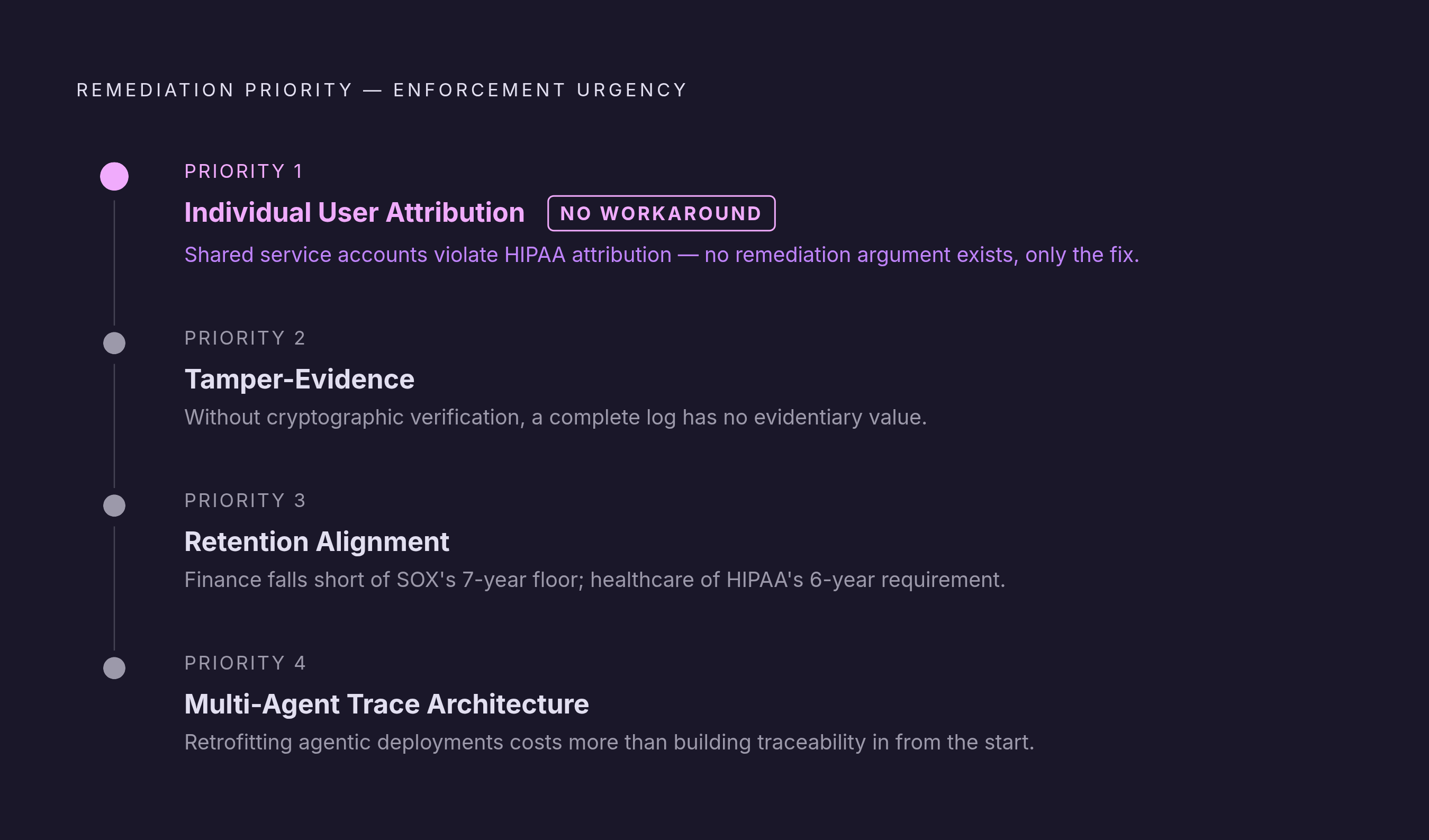
No organization can close every logging gap at once, so the order of attack should follow enforcement risk: individual user attribution first, tamper-evidence second, retention alignment third, multi-agent trace architecture fourth. Individual user attribution comes first because it is the gap most likely to produce an immediate finding. AI systems accessing regulated data under a service account fail HIPAA's individual attribution requirement on their face, and there's no remediation argument available for that failure, only the remediation itself.
Tamper-evidence comes second because it is what turns a complete log into a legally defensible one; a log that can be altered after the fact carries no evidentiary value no matter how many fields it captures. Retention alignment comes third: finance organizations typically find a gap of years between their current retention policy and SOX's seven-year floor for audit work papers, and healthcare organizations face a comparable gap against HIPAA's six-year requirement. Multi-agent trace architecture comes fourth because it affects organizations running agentic workflows today, a deployment pattern that is growing but not yet universal; organizations building new agentic systems should design this logging in from the outset rather than retrofitting it onto a system already in production, since the cost and error rate of retrofitting run materially higher than building it in from the start.
The proof bundle, combining decision output, environmental snapshot, authorization chain, oversight documentation, and XAI rationale into one immutable record, should be the design target for any new AI system entering a regulated workflow, because assembling it retrospectively out of siloed logs is expensive and frequently incomplete. Neither team can satisfy the requirement alone, and every framework covered here expects both halves of that work to hold up under examination.
Sources
- AI Regulation 2026: Current Laws, Compliance Requirements, and What's Next
Provided the overview of the three-layer regulatory framework, the count of countries enacting AI-specific legislation, and the sector-specific frameworks including CMMC and NYDFS Part 500.
- Governed Auditable Decisioning Under Uncertainty: Synthesis and Agentic Extension
Supplied the framing of governed auditable decisioning extended to agentic contexts as a continuous chain of evidence across the full decision and action sequence.
- Right to History: A Sovereignty Kernel for Verifiable AI Agent Execution
Informed the section on cryptographic verification of execution history and the sovereignty/traceability architecture for verifiable AI agent execution.
- Decision Trace Schema for Governance Evidence in Real-Time Risk Systems
Provided the reference architecture for assembling decision output, environmental snapshot, authorization, and oversight layers into a single immutable governance record.
- Governance-as-Code: Translating EU AI Act Technical Requirements into Executable Compliance Pipelines for Generative AI Systems
Informed the analysis of EU AI Act Recitals 99 and 100 and how they apply to each agent performing a high-risk function in a multi-agent pipeline.
- Runtime Governance for AI Agents: Policies on Paths
Provided the technical model for recording runtime governance enforcement decisions on execution paths rather than inferring them from outputs after the fact.
- Audit Trails for Accountability in Large Language Models
Established the requirement that regulators and auditors assess each decision point along the chain of reasoning across delegated steps in LLM-based systems.