Human-in-the-Loop Checkpoints for Autonomous Agents
Prevent cascading failures by placing checkpoints where mistakes can't be quietly undone.

Autonomous agents don't fail because they're autonomous. They fail because nobody decided, in advance, exactly where a human needs to step in and stop the workflow before it does something that can't be quietly undone. Most teams treat human-in-the-loop as a single dial: turn it up for caution, down for speed. That model is wrong, and it's the reason so many checkpoints end up sitting in the wrong place entirely.
The pattern is familiar to anyone running these systems at scale. A team deploys an agent, it runs clean for weeks, then something goes sideways. A support complaint gets misclassified and routed to the wrong queue, a draft email fires off a day early, a data record gets overwritten with no backup. The instinct is to blame the model. That instinct is almost always wrong: in nearly every postmortem, the actual cause is that the workflow had no checkpoint at the exact place where the damage happened.
Full autonomy makes sense in narrow, low-stakes, predictable contexts: parsing logs, generating scheduled reports, tagging inbound forms. Most real business workflows aren't that. They involve steps that build on each other, so errors compound instead of staying contained. A bad decision at step three corrupts the context an agent uses at step four, which then feeds bad data into step five, and by the time a human notices, the root cause is buried three or four layers back. Untangling it costs far more than a pause at step three would have.
AvePoint's State of AI 2026 Report found that 95.5% of organizations took at least one action to mitigate agent-related security risk after an incident, and human-in-the-loop review was among the responses teams reached for. That's not a sign that agents got worse. It's a sign they got fast enough that mistakes started propagating before anyone had a chance to catch them, which makes the real question not whether to add checkpoints but where they belong, decided before the incident rather than dissected after it.
What HITL actually means in an agentic context, versus what most teams think it means
The term predates agentic AI by a good stretch. It originally described human review inside machine learning training and labeling pipelines, where the question was simple: did a person check the output before it got used? That question has changed shape. In an agentic system, the output is an action taken inside a live system, and what matters is whether a human approved that action before it executed, not whether someone glanced at it afterward.
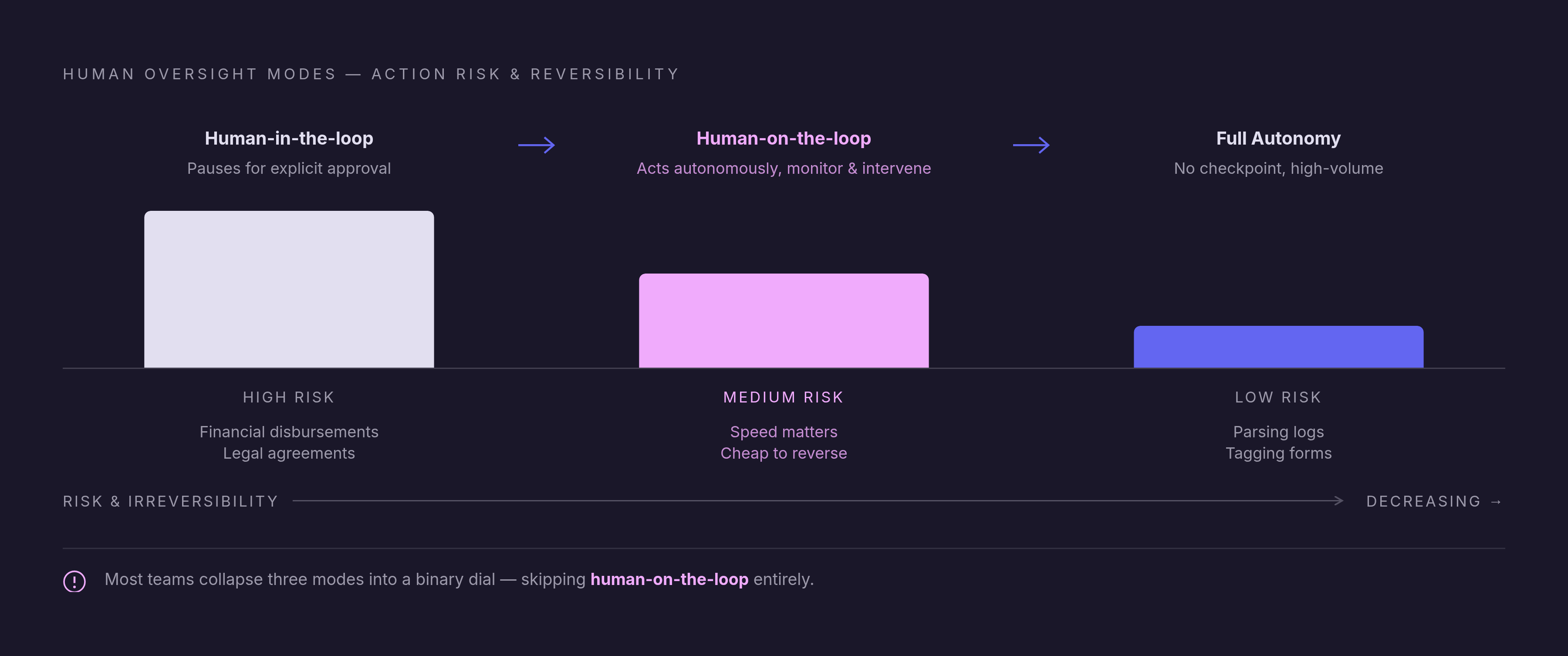
Oversight isn't binary, and treating it that way is the mistake behind most broken governance plans. There are three distinct modes, and collapsing them into one dial is where things fall apart.
Human-in-the-loop, properly defined, means the system pauses and waits for explicit approval before the action executes. It fits high-risk, hard-to-reverse decisions: financial disbursements, legal agreements, anything touching sensitive data access. Human-on-the-loop means the agent acts on its own, and a person monitors the outcome with the ability to intervene after the fact, suited to medium-risk scenarios where speed matters more than pre-approval and mistakes are cheap to reverse. Full autonomy means no checkpoint anywhere in the chain, and it belongs only in low-risk, high-volume, easily reversible territory.
In practice, the most common HITL pattern looks like this: the agent completes a step, pauses, and waits for a human to click approve before moving forward. It shows up most often around outbound communications, financial actions, content publishing, anything that triggers a system outside the agent's own sandbox.
Here's the distinction worth being blunt about. Putting a person "in the loop" without training them on what they're approving, when to escalate, or how to recognize the moment they've stopped paying close attention, is a formality, liability wearing the costume of process. HITL is also not evaluation, which measures quality offline after the fact, and it's not observability, which just records what happened. HITL is the designed boundary between what an agent can do on its own and what requires a human decision, plus the architecture that actually enforces that boundary rather than describing it in a document nobody rereads.
How to decide where checkpoints belong: the blast-radius test
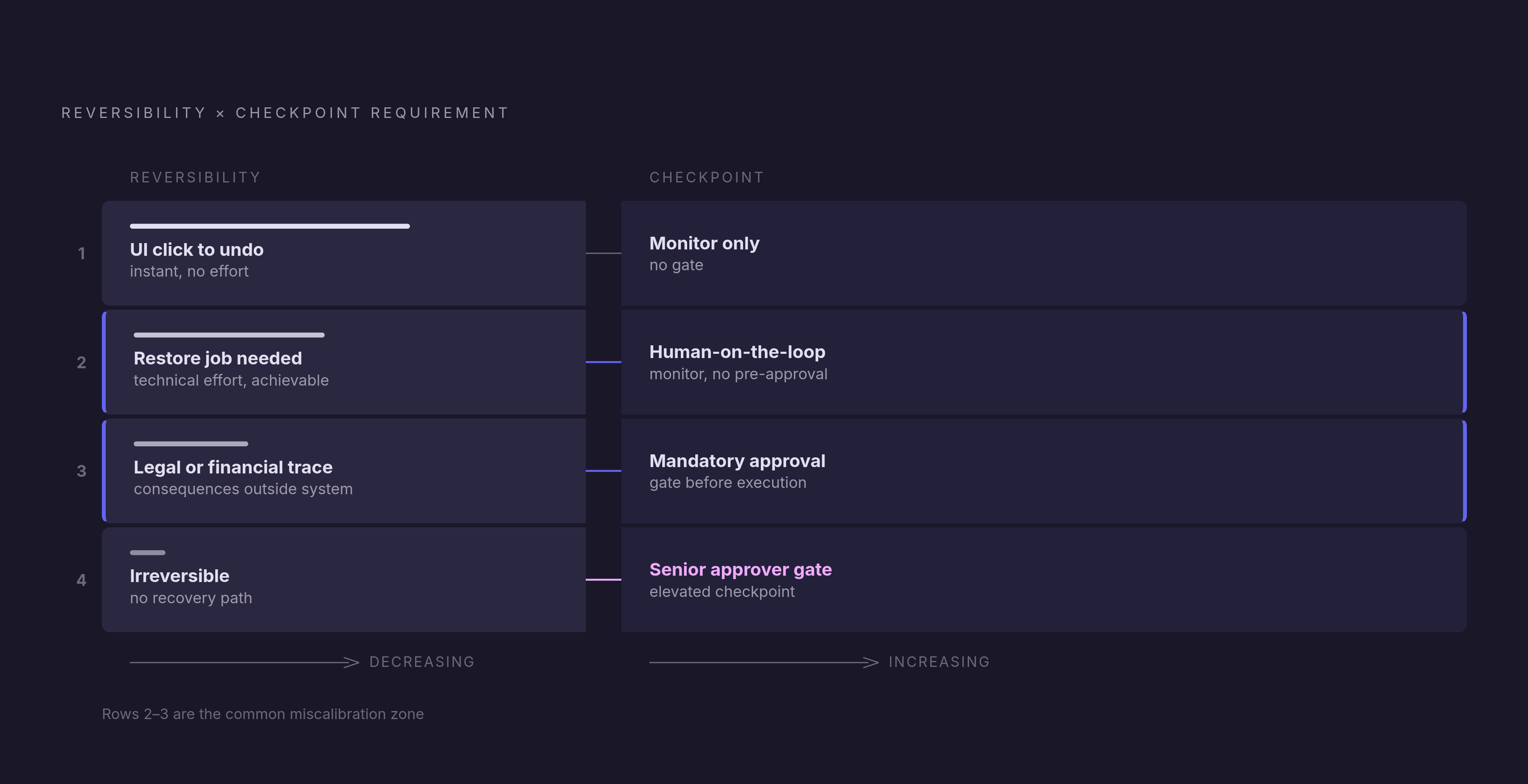
Agent capability isn't the variable that matters here. What matters is how hard it would be to undo an action once the agent has taken it. So the analysis starts from the action itself, not from the agent: list everything a given agent can do, then ask, for each item, what it would take to reverse it.
Four categories fall out of that question, and each implies a different checkpoint logic. An action undone with a click in the UI needs nothing more than monitoring. An action that requires a restore job, technical effort but ultimately achievable, is well served by human-on-the-loop monitoring rather than a pre-approval gate. An action that produces a legal disclosure or a financial reconciliation, something with consequences outside the system that can't be quietly walked back, needs a mandatory approval checkpoint before it executes. And an action that's simply irreversible needs that same mandatory checkpoint, elevated to a senior approver where the stakes justify it.
Requiring approval on every single action defeats the point of automation. Knowing which actions don't need a gate is just as important as knowing which ones do, and teams that skip this discipline end up with approval fatigue standing in for safety, which is worse than no safety net at all.
Agentic workflows complicate this further because risk isn't constant within a single run. An agent that books a flight and then, later in the same session, negotiates terms on a vendor contract has moved from a low-stakes action to a high-stakes one without changing identity. The oversight model has to follow the action, not the agent, which means it needs to be dynamic and policy-driven rather than fixed once at setup.
The window for catching a mistake has also gotten a lot shorter. Agents query APIs, modify infrastructure, move money, send messages, and kick off downstream workflows, often within the same few seconds. A wrong payment, an unauthorized data pull, a misconfigured system setting: none of these sit quietly waiting to be found. They're immediate.
Automation bias deserves naming directly, because it's the counter-risk most checkpoint designs ignore. Humans placed "in the loop" tend to trust AI output more than the evidence warrants, especially after a stretch of smooth operation lulls them into treating the review step as a formality. Assuming a reviewer will stay critically engaged forever, with no support, is wishful thinking. It's a design flaw baked in from the start.
The action categories that most consistently require a mandatory pause
Certain categories show up at the top of nearly every blast-radius analysis, regardless of industry.
Outbound communications sit near the top of that list. A draft email or a customer message, once sent, exists in the recipient's inbox no matter what the agent actually intended by it. This category is also among the most common sources of real agent-related incidents, because the cost of sending something wrong is instant and visible to someone outside the organization.
Financial actions carry their own weight: payments, refunds, disbursements, anything that commits to a contract. A wrong amount or an unauthorized transfer is a serious failure. It's a legal and financial event the moment it clears.
Data modification and deletion belong here too, particularly records that can't be reconstructed once they're gone. This gets more dangerous in multi-agent workflows, where one agent's output becomes the next agent's input, so a bad write early in the chain doesn't just corrupt one record. It corrupts everything downstream that trusted it.
Content publishing deserves its own line, since anything that goes live on a public site, gets sent to a distribution list, or gets indexed by an external system is effectively permanent in terms of who has already seen it, whatever happens to the source afterward.
Access and permission changes round out the list, and a vulnerability disclosed in Salesforce's Agentforce in 2025 shows exactly why a single gate isn't enough. The safeguard protecting that action failed through a gap in how trusted domains were verified, and the allowlist that was supposed to contain the damage offered no real protection once that gap was exploited. One gate, no backup, and the whole safeguard collapsed on a technicality nobody had priced into the design.
Inter-agent handoffs deserve mention as their own category. When one agent spawns or delegates to another with broader permissions, that transition point is a natural checkpoint candidate, since the sub-agent may end up holding access the original human authorizer never actually signed off on.
Research out of the University of Tokyo and the University of Illinois Chicago, published as HAS-Bench in 2026, mapped three distinct channels where human input changes agent outcomes: clarification, which resolves ambiguity before the agent commits to a path, feedback, which corrects intermediate output while the task is still running, and control, which authorizes or vetoes a risky or irreversible action before it fires. Across six domains, the study found human participation meaningfully improved both task completion and recovery from failure, but the gains depended heavily on when the input arrived, how it was delivered, and who was delivering it. A checkpoint in the wrong place, staffed by the wrong person, doesn't help much even when it technically exists.
Designing the checkpoint itself so the human review is genuinely useful
Knowing where a checkpoint belongs is only half the job. The pause itself has to be built so the person standing inside it can make a good call, and that depends on three things: timely context, real authority, and a defensible rationale for whatever they decide.
Context means the agent surfaces enough for the reviewer to actually evaluate what's in front of them, not just a bare "approve this?" prompt. A reviewer needs to know what the action is, what triggered it, what changes if it goes through, and what happens if it's rejected instead. Authority means the approval request lands with someone who genuinely has the standing to make that call. Routing a financial disbursement to a junior team member who can't authorize spending is a broken checkpoint. It's a formality with no teeth behind it.
Time-boxing matters more than it sounds like it should. An approval queue with no deadline turns into a bottleneck, and teams under pressure learn to clear bottlenecks by approving without reading. Decision windows need enforced limits, or the checkpoint quietly turns into a rubber stamp.
None of this works without an identity-aware orchestration layer underneath it, one that can pause execution, route the request to the right authorized person, enforce the time limit, and log the whole interaction for audit. Without that layer, HITL is a policy written down somewhere, not something the system actually enforces.
Rollback deserves treatment as its own checkpoint pattern, not an afterthought. When agents can modify files or records without asking first, the ability to undo becomes part of the safety net. Claude Code's checkpoint system, for instance, automatically saves code state before each change and allows an instant rewind if something goes wrong. RedMonk's 2025 analysis of agentic development tools noted that demand for checkpoints and rollbacks is one developers raise often, which says something about how developers, of all people, actually trust these systems in practice.
Aviation offers a useful comparison here, without needing to lean on it too hard. Crew Resource Management, brought in structured briefings, coordinated decision-making protocols, and no-blame debriefs, and the discipline of building human oversight into routine operations became standard practice as a result. Enterprise AI sits at roughly the same point now: oversight needs to become an operational habit built into how the work gets done, not a diagram that lives in a runbook nobody rereads. Reviewers need to practice these decisions before a live incident forces them to make one for the first time under pressure.
The governance and regulatory pressure that makes checkpoint design non-optional
Regulators have stopped treating this as optional, and the deadlines are specific enough now to plan around.
The EU AI Act, Regulation (EU) 2024/1689, addresses this directly in Article 14 on human oversight and Article 15 on accuracy, robustness, and cybersecurity, both of which apply to autonomous agents operating in high-risk domains. The compliance deadline, pushed from August 2026 to December 2027 under the Digital Omnibus on AI, makes demonstrable oversight a legal requirement rather than a best practice. A policy document isn't enough anymore. Organizations need provable, auditable oversight that a regulator can actually inspect.
Singapore's IMDA released a Model AI Governance Framework for Agentic AI in January 2026, the first governance framework built specifically around autonomous agents. It's voluntary, not binding, but it recommends that agent identity and authorization chains be traceable, supporting the kind of audit trail that shows who acted under whose authorization.
NIST has moved in the same direction. Its AI 100-2 update in March 2025 named AI agents as a threat surface for the first time. NIST IR 8596, released as a preliminary draft in December 2025, maps cybersecurity framework functions onto AI-specific risks, agentic threats included, and the agency's Center for AI Standards and Innovation launched an AI Agent Standards Initiative in February 2026 to build that mapping out further.
Emerging governance frameworks for agentic applications highlight a range of priority risks, including goal hijacking, tool misuse, identity and privilege abuse, missing guardrails, and over-reliance on autonomous decisions. Missing HITL checkpoints are directly relevant to several of those risk categories, which says something about how central this one control is to the whole list.
The Cloud Security Alliance, building on the NIST AI Risk Management Framework, defines four autonomy tiers with escalating oversight requirements, running from fully supervised, where every output needs approval before it acts, up through full autonomy capable of spawning its own sub-agents. Oversight cadence scales with the tier, giving organizations a structure for tiering their own fleet of agents instead of applying one policy across everything they run.
Gartner forecast that over 40% of agentic AI projects will be canceled by the end of 2027, citing escalating costs, unclear business value, and inadequate risk controls as the drivers. Governance failure, not model quality, is the preventable cause behind most of that number, and it's the one most within a team's control to fix before it shows up as a cancellation.
The full framework runs across six control layers: identity and authentication, least-privilege access, behavioral monitoring, human oversight checkpoints, audit logging, and supply chain security. HITL is one layer among six, not a standalone program bolted on and called done. Under Singapore's framework, the audit trail requirement means every checkpoint interaction, who approved it, what they were shown, when they decided, has to be recorded. That makes the quality of a checkpoint's design something a regulator can actually see, not something that stays internal.
How agencies managing AI workflows across multiple client brands apply this in practice
Portfolio scale changes the math. An agency running agentic content or visibility workflows across dozens of client accounts can't apply one checkpoint policy uniformly, and pretending otherwise is how agencies end up over-gating the low-risk accounts while under-gating the ones that actually need it. A regulated financial services client and a consumer lifestyle brand don't carry the same blast radius for the same category of action, even when the underlying agent is identical.
The blast-radius test still applies, just at the client level instead of the platform level. Outbound communications for a financial client might need senior sign-off before anything sends. The identical action, run for a low-risk consumer brand, might only need monitoring after the fact. Checkpoint policies need to be configurable per client rather than fixed once at the platform level: the same least-privilege logic that governs access, applied instead to oversight, with the client's risk profile setting the checkpoint rather than the agency's default.
Agencies carry a second HITL problem that's easy to overlook: client-facing reporting. When an agent generates a performance report or a content recommendation headed for a client's desk, that output is itself a high-stakes action. It shapes a client's decisions, and it's attributed to the agency's own expertise. Review before delivery is essential here. It's a checkpoint in the fullest sense.
Enablement is part of the design, not a separate training exercise tacked on afterward. A reviewer who doesn't understand what a checkpoint is actually surfacing produces a rubber stamp, no matter how well the checkpoint itself was engineered. Account managers need training to recognize what they're looking at and what a well-reasoned approval or rejection actually looks like inside an AI content or visibility workflow.
Platforms designed for agency workflows can build this logic into the operating model rather than leaving it to individual account teams to improvise. That approach can give agencies a unified workspace for managing a portfolio, with controls over access and accountability built in from the start, structured reporting and audit trails that give account teams the evidence they need when a client asks how a decision was made, and a dedicated enablement process that trains sales reps and account managers to speak credibly about AI visibility rather than defer entirely to the tool. The cumulative view across a whole portfolio carries a governance benefit beyond reporting, too: an agent behaving strangely on one account tends to show up in aggregate patterns before it shows up as a formal complaint from that one client.
The ongoing calibration problem: checkpoints drift if no one owns them
Checkpoints set at launch reflect the risk profile the workflow had at launch. That profile doesn't hold still. As an agent picks up new tools, broader permissions, or access to data sources it didn't have before, its blast radius changes, and the checkpoint map drawn up on day one doesn't update itself to match.
The failure pattern is predictable enough to name. A workflow runs cleanly for months, confidence builds, and approval steps start getting skipped informally or stripped out entirely as "unnecessary friction." That's automation bias again, just operating at the organizational level instead of the individual reviewer's desk.
Two events should force a checkpoint review every time. Any change to what an agent can access or act on, a new API connection, expanded data permissions, an added tool, needs a fresh look at whether the existing checkpoints still cover the new blast radius. And any incident in a comparable workflow, even one at a different organization entirely, counts as evidence worth taking seriously: if a category of action turned out to carry more risk than expected somewhere else, that's a signal your own checkpoint for that same category might be calibrated too loosely.
Audit logs are the diagnostic tool for catching this drift before it turns into an incident. A log showing approvals clustering suspiciously fast, or the same reviewer clearing dozens of requests in a pattern that doesn't match the complexity of what they're approving, is telling you the checkpoint has stopped functioning as a checkpoint and started functioning as a formality. Someone has to own that review on an ongoing basis. Left to nobody in particular, it belongs to nobody at all, and that's exactly the condition under which the next incident starts building.
Sources
- Human-in-the-Loop AI: When (and Why) Machines Still Need a Person (2026) | AvePoint
- 10 Things Developers Want from their Agentic IDEs in 2025
- HAS-Bench: Evaluating LLM-Based Human-Agent Systems under Configurable Human Participation
- What is Generative Engine Optimization? GEO vs AEO vs SEO Guide 2026 | The Jasper Blog
- labs.cloudsecurityalliance.org