Stdio vs HTTP SSE Transport in MCP Deployments
Stdio works locally but scales to zero; Streamable HTTP handles remote teams and audit trails.
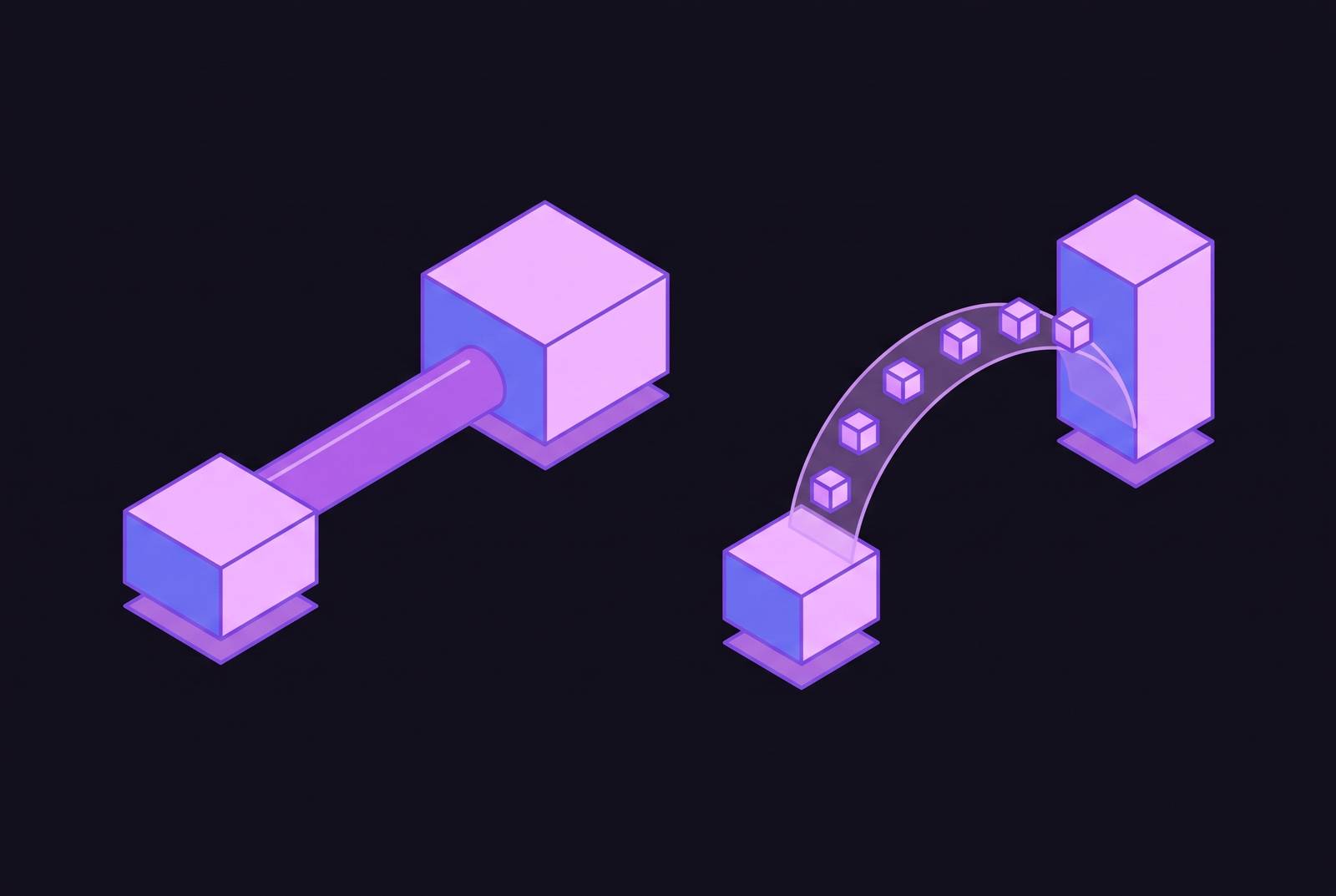
MCP transport choice decides three things before a single line of tool code runs: whether a server can serve one client or a hundred, whether authentication is even structurally possible, and whether anyone can produce an audit log when a compliance officer asks for one. Model Context Protocol, the standard Anthropic introduced in late 2024 for connecting AI agents to outside tools and data, splits cleanly into two layers. The data layer defines the protocol's actual vocabulary: tools, resources, prompts, capability negotiation, all carried as JSON-RPC 2.0 messages. The transport layer just moves those messages around, and swapping it never changes what a tool does. It changes who can reach the tool, how, and whether that access leaves a trace behind.
How the MCP specification evolved from two transports to two different transports
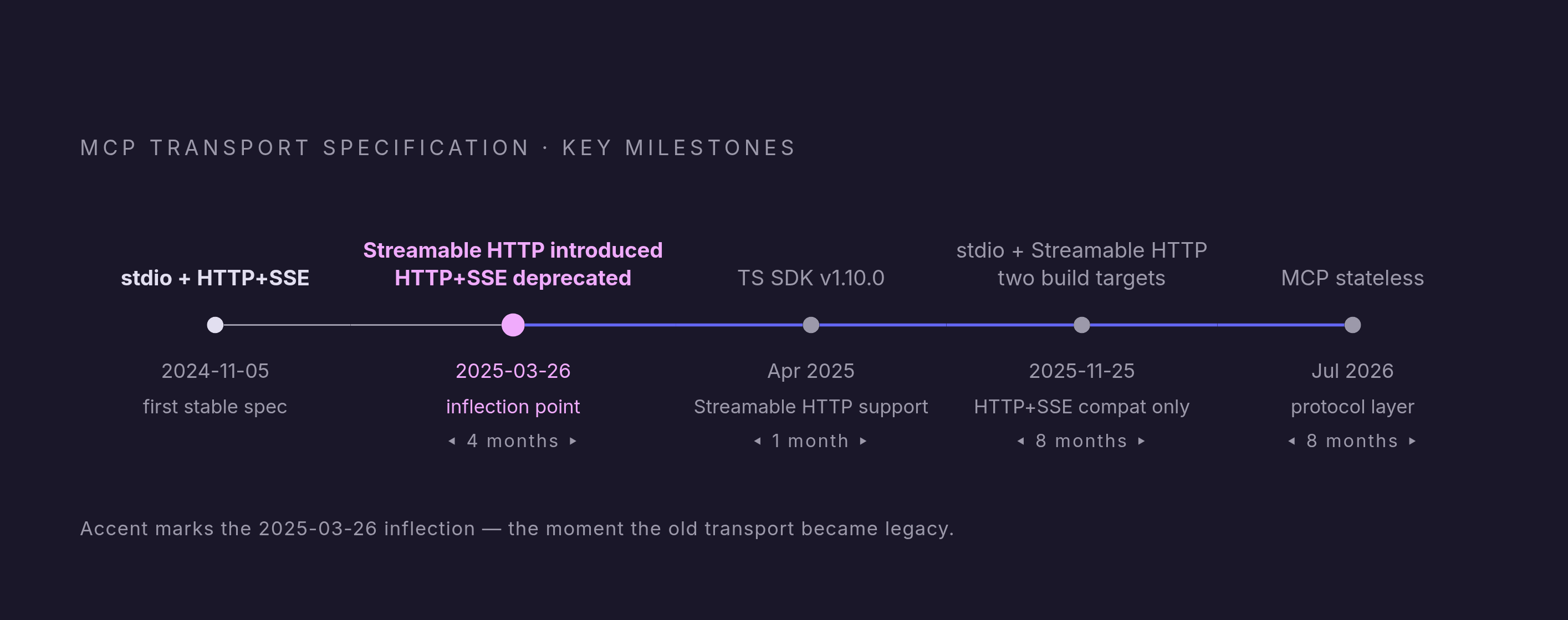
The first stable spec, dated 2024-11-05, shipped with two standard transports: stdio and HTTP+SSE. Both worked at launch. Only one aged well, and pretending otherwise now is just nostalgia.
By 2025-03-26, the spec introduced Streamable HTTP and, on that same date, formally deprecated HTTP+SSE. The TypeScript SDK caught up a few weeks later: version 1.10.0, shipped in April 2025, carried the first SDK-level support for Streamable HTTP. The 2025-11-25 spec kept HTTP+SSE around strictly for backward compatibility, while stdio and Streamable HTTP became the two transports anyone should actually build against. The July 2026 spec pushed further still, making MCP stateless at the protocol layer.
Governance shifted right alongside the technical spec. On December 9, 2025, Anthropic donated MCP to the Agentic AI Foundation under the Linux Foundation, with platinum members including AWS, Anthropic, Block, Bloomberg, Cloudflare, Google, Microsoft, and OpenAI. That list matters more than it looks at first glance: MCP stopped being one company's roadmap and became something closer to a shared utility, the way HTTP or TLS belongs to no single vendor.
A 2024 tutorial, or a vendor slide still advertising "SSE transport" as a selling point, is working from a foundation the spec has already moved past. Knowing these dates is the fastest way to catch that kind of thing before it costs a rebuild.
Stdio: what it does well and exactly where it stops working
Stdio is about as plain as a transport gets, and that's the whole point of it. The client launches the MCP server as a subprocess on the same machine. The server reads JSON-RPC 2.0 messages off stdin and writes responses to stdout, one newline-delimited UTF-8 message per line, with logs routed to stderr so they don't pollute the message stream.
That last detail is where most stdio servers actually break. Nothing that isn't a valid MCP message can hit stdout, so a stray console.log() or a debug print() statement lands in the same stream the client is parsing as protocol data, and the client either hangs or drops the connection outright. It's the single most common failure mode anyone building a stdio server runs into, and it's almost always a logging mistake, not a bug in the protocol itself.
In exchange for that fragility, stdio buys speed and simplicity nothing else on the table matches. Benchmarked round-trip latency comes in around 12.4 milliseconds for stdio versus 23.7 milliseconds for HTTP/SSE, roughly double the speed at the protocol layer (per arxiv.org/html/2601.17549v1). There's no network hop, no auth handshake, no firewall rule to write. When the client process exits, the OS just reclaims the server along with it. Distribution is zero-infrastructure: ship a package, and the client runs it locally. That's exactly why Claude Desktop, Claude Code, Cursor, Windsurf, and Roo Code all default to launching MCP servers as stdio subprocesses. It's the lowest common denominator every client agrees on.
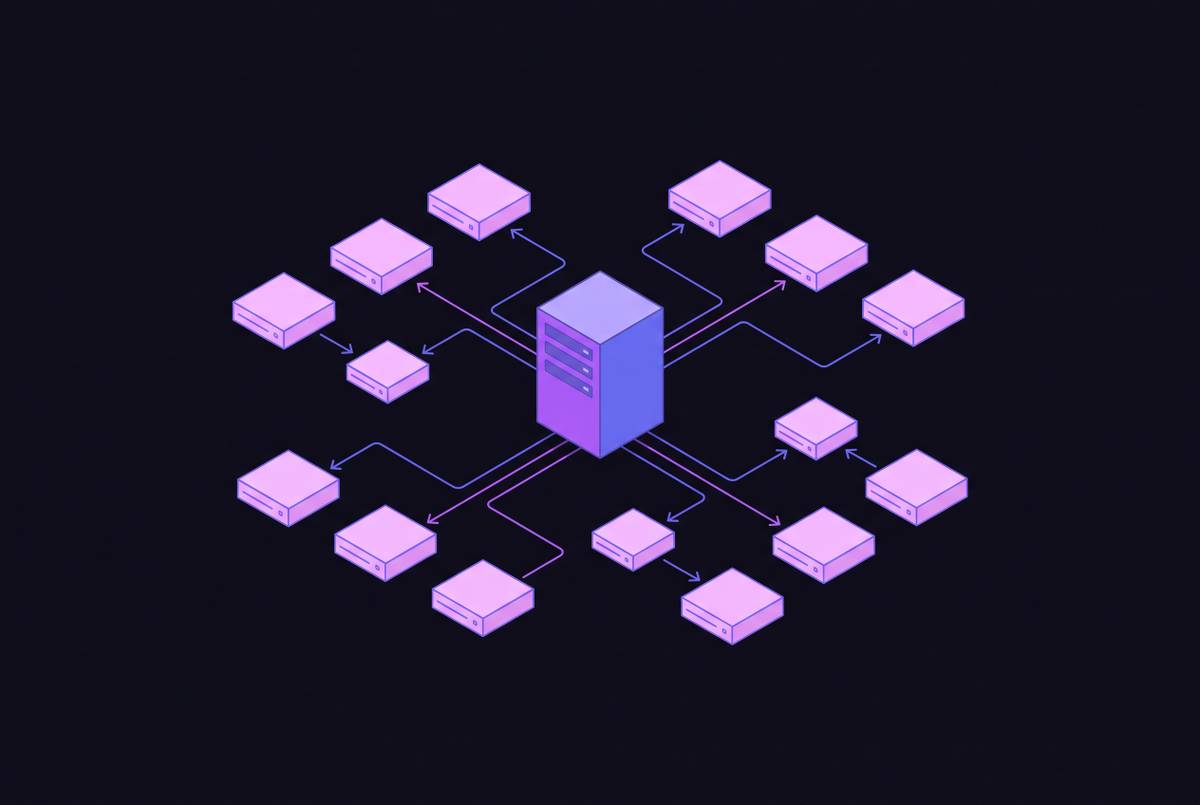
The ceiling shows up the moment more than one person needs the same server, and it shows up hard. Stdio is a process-per-client model, full stop. Fifty developers running eight servers each isn't fifty connections to eight shared services. It's roughly 400 separate processes scattered across fifty different laptops, each with its own memory, its own state, its own copy of whatever the server loaded on startup. Nothing is shared, and nothing is centrally visible.
That invisibility turns into a real headache the first time someone asks who used a tool and when. Every JSON-RPC exchange lives inside stderr output on an individual developer's machine, with no shared clock, no consistent schema, and no correlation ID tying one call to the next. Answering something as basic as "which developers called this tool in the last thirty days" can eat a week and still come back incomplete. That's not sloppy engineering. It's a direct consequence of picking a transport that was never built to be watched from outside.
Auth suffers the same fate, and here the limitation is total rather than partial. Stdio has no transport-level authentication mechanism at all, just whatever environment variables a developer happens to export. There's no gateway to sit in front of it, no natural point to intercept a call and check identity. Any audit trail or identity mapping has to get rebuilt after the fact, host by host, and that reconstruction work is exactly the kind of thing that never actually gets done under deadline pressure.
None of this makes stdio a bad choice. It's the right choice for a specific shape of problem: personal tools, local filesystem wrappers, CLI utilities, database connectors running next to an IDE, anything where server and client live on the same machine and only one person needs access. Stdio is widely treated as the default starting point for new server development, and that's sound advice, provided the deployment never grows past a single user on a single box. Where people go wrong is stretching it past that box because it was easy to set up, then acting surprised when nobody can say who touched what.
HTTP+SSE: the structural problems that made deprecation inevitable
The original remote transport, defined in the 2024-11-05 spec, split communication across two separate endpoints. A client would open a long-lived GET connection to /sse, and the server's first event on that stream would tell the client where to POST its own messages, typically something like /messages?sessionId=…. From there, every server-to-client message rode that same persistent SSE stream for as long as the session lasted.
It worked, and plenty of early MCP deployments ran on exactly this design without incident. But three structural problems made it a dead end for anything beyond a small deployment, and none of them were fixable with a patch.
There was no way to resume a dropped stream. If the connection died mid-session, whatever messages were in flight were simply gone, with no mechanism to replay them, which is a rough thing to discover in production.
The whole design also demanded a stateful, persistent connection per client, which sits close to the opposite of what modern infrastructure wants. Serverless platforms and CDN-fronted deployments are built around short-lived, stateless requests. Forcing a server to hold open a long-lived SSE connection per client fights that model directly, and it makes horizontal scaling genuinely painful.
And the channel itself was asymmetric. SSE only flows server to client, so clients needed an entirely separate POST channel for the other direction: two endpoints, two connection lifecycles, and a load balancer that now has to track which client's POST requests belong to which SSE stream. That's a lot of moving parts for what should be a straightforward back-and-forth.
The spec deprecated HTTP+SSE officially on 2025-03-26, and the 2025-11-25 spec retained backward-compatibility provisions, though servers may still host SSE endpoints for older clients. No new implementation should target it. That's not a hedge, it's the plain reading of where the spec has gone, and vendors who still pitch it as current are either behind or hoping nobody checks the date.
Platforms have already put dates on the wall. Keboola has set April 1, 2026 as its removal date for HTTP+SSE. Atlassian Rovo has set June 30, 2026. Those aren't soft suggestions. They're shutdown dates.
A server still marketing HTTP+SSE as its primary transport is a signal worth asking about when evaluating a vendor. It might mean the vendor hasn't kept pace with the spec. It might mean they're supporting a specific legacy client on purpose. Either way, it deserves a direct question before anyone signs anything.
If an existing SSE server is already running somewhere, there's no fire drill required. It still functions, and the spec's backward-compatibility guidance covers it. Migrate when the code is next touched for another reason. For anything new, though, there's no case for building against HTTP+SSE at all.
Streamable HTTP: the current remote standard and how it fixes what SSE broke
Streamable HTTP collapses the two-endpoint design into one. A server exposes a single URL, commonly something like /mcp, that accepts both POST and GET. Clients POST their JSON-RPC messages to it, and the server answers either with a plain JSON body for a quick response or upgrades that same exchange into an SSE stream when a call is going to take a while. No separate events endpoint, no second connection lifecycle to track.
Every failure mode from the old transport gets addressed directly, and it's worth naming each fix against the break it patches. Resumability comes from Last-Event-ID replay, so a dropped connection can pick back up instead of losing messages outright. The stateless-friendly design means a server can just answer with plain JSON and close the connection, which maps cleanly onto serverless functions and short-lived containers, the exact deployment shapes SSE fought against. Collapsing everything onto one endpoint removes the routing complexity that made the old two-endpoint model such a pain to load-balance.
The bigger shift is what single-endpoint, connection-agnostic design unlocks: a server can now run as one long-lived process handling many concurrent clients at once, instead of spinning up a fresh process per user the way stdio does. That's the real dividing line between the two active transports, more than any latency number you'll see quoted.
Because requests now carry a standard Authorization header, a gateway sitting in front of the server has a real, structural place to intercept a call and check identity, something stdio simply cannot offer at any price. The spec strongly recommends OAuth 2.1, and requires it wherever authorization is implemented at all. ChatGPT's MCP integration, launched in 2025, runs on exactly this pattern: Streamable HTTP paired with OAuth 2.1, using Client ID Metadata Documents as the preferred way to register clients and Dynamic Client Registration kept around as a fallback.
What that buys, in exchange for now having to run and maintain a gateway, is centralized identity, a real audit trail, rate limiting, role-based access control, and the ability to scale the server tier horizontally.
One caveat holds even here. Stateful sessions still don't play cleanly with load balancers unless session affinity gets configured, since a client can land on a node that has no idea a given session exists. The 2026 MCP roadmap lists transport scalability, covering session handling, horizontal scaling, and server discovery, as an open priority. That tells you this is still an area under active work, not a solved problem.
In practice, most teams don't pick one transport and abandon the other. Most MCP SDKs let a single server bind to multiple transports at once, so stdio covers local development while Streamable HTTP handles production, switched by an environment variable or a command-line flag. Because tool logic lives in the data layer, only the transport initialization code changes between the two. Migrating an existing stdio server isn't a rewrite. It's a small patch to how the server starts up, with everything else left alone.
Security exposure by transport, and what to do about it
MCP adoption picked up fast through 2025, spreading across ChatGPT, Claude, Cursor, Gemini, Microsoft Copilot, and VS Code. Security maturity did not keep pace, and the gap between the two is the actual story here. Independent scans have repeatedly found that a large majority of public MCP servers carry some exploitable flaw, and only a small fraction bother with OAuth at all.
The CVE count backs that up. More than 40 CVEs were disclosed against MCP between January and April 2026 alone, and one of them, CVE-2025-6514, scored a 9.6 on the CVSS scale and hit the widely used mcp-remote proxy package across a very large number of already-installed environments.
Stdio's specific weakness traces straight back to its architecture. MCP over stdio doesn't sanitize the command strings it spawns, and because the whole model is subprocess-based, command execution is effectively the default interface a malicious payload gets handed. Survey data on sampled implementations found the majority vulnerable to path traversal, with a large share also carrying injection risk on top of that. That risk compounds with a known weakness of the language models themselves: an LLM cannot reliably tell the difference between a system instruction and untrusted data sitting inside a tool call's arguments, which makes prompt injection through a tool call a realistic path into the system, not a theoretical one.
The fix isn't exotic. Sandbox the process, strictly, and never run an MCP server directly against the host OS. Wrap it in an isolated Docker container or a microVM like Firecracker instead. Docker's own MCP Toolkit, available since May 2025 and built into Docker Desktop since June 2025, runs each server in its own container with no host filesystem access by default, authorized with a single CLI command or a single click, and it's available on every Docker Desktop plan, including the free Personal tier. That's a low bar to clear for a real reduction in blast radius, which is exactly why skipping it has no good excuse.
Streamable HTTP's security model is layered differently, and it gets built out with each spec revision. OAuth 2.1 is mandatory under the spec. The 2025-06-18 update added Protected Resource Metadata (RFC 9728) and Resource Indicators (RFC 8707). The 2025-11-25 update added Client ID Metadata Documents, while downgrading Dynamic Client Registration, which predates both updates, to optional. On paper, that's a fairly complete authorization stack.
In practice, the spec still leaves authorization technically optional, and a scan of the public internet in July 2025 found a substantial number of publicly reachable MCP instances answering requests with no authentication at all. A strong spec on paper and a spec that's actually implemented are two different documents, and right now the gap between them is wide enough to drive a truck through. The honest read is that Streamable HTTP fixed the transport's structural problems, not the industry's habit of shipping it wide open.
That gap sits inside a larger organizational one. Per the Cisco AI Readiness Index 2025, a large majority of businesses plan to roll out agentic AI, but under a quarter currently have safety controls like live tracking and guardrails in place. Transport security decisions, in other words, are getting made by organizations that haven't finished building the muscle to make them well, and that mismatch is the actual risk, more than any single CVE.
Enterprise and multi-client deployments: where transport choice becomes an operational policy
Enterprise MCP deployments rarely involve one server and one client. They involve multiple servers serving multiple agents across multiple teams, and each of those connections needs its own authentication, its own access control, its own data protection, and its own logging. A team running several agents, each wired into several MCP servers, ends up managing a sizable credential inventory, and every credential in that inventory carries its own provisioning process, its own rotation schedule, its own expiration date to track.
Stdio simply cannot meet several requirements that show up the moment an organization gets past a handful of users, and no amount of scripting fixes that. Single sign-on through SAML or OIDC has nowhere to plug in. Role-based access to individual tools inside a server isn't structurally possible. Read-only access for an auditor, credential management that doesn't involve someone pasting an API key into Slack, none of it fits the process-per-client model stdio is built on.
That's the gap gateways exist to close. A gateway sits between MCP clients and MCP servers and centralizes security, access, and the operational overhead that would otherwise fall on every team individually. Microsoft, for instance, offers an open-source gateway for Azure Kubernetes Service and Azure API Management, alongside a commercial option, both built on Azure Active Directory (Entra ID) for enterprise authentication.
Deployment shapes for this tend to fall into four topologies, according to reporting from digitalapplied.com in May 2026, ranging from a single-tenant stdio setup at the small end to a federated gateway spanning a large server estate at the other. Transport choice is the gate between those tiers, and there's no backing into a federated deployment starting from stdio. The architecture has to be chosen up front, before the credential sprawl starts, not after.
Analysts see this becoming standard infrastructure rather than something each company builds from scratch. Gartner's 2025 Software Engineering Survey projects that by 2026, a large majority of API gateway vendors, and roughly half of iPaaS vendors, will ship MCP features natively.
MCP is also starting to sit inside a broader stack rather than standing alone. MCP handles tool access, A2A (with IBM's ACP folded into it in August 2025, both now under the Linux Foundation, and A2A itself joining the Agentic AI Foundation in August 2026) handles coordination between agents, and Streamable HTTP runs underneath both as the shared transport layer. Streamable HTTP, at this point, is the connective tissue of the whole agentic stack, not a footnote specific to MCP.
A concrete case shows what this looks like outside the abstract. Guideline, a provider of Ad Intelligence and Media Plan Management technology, launched a Media Plan Management MCP Server on March 5, 2026 (per PR Newswire), letting advertising agencies, media buyers, and enterprise clients connect their own AI agents straight into its platform. Before that, media planning workflows meant bouncing between multiple platforms, exporting data by hand, and compiling reports manually. An MCP server built on Streamable HTTP replaces that manual integration work with a direct connection, and that replacement is the whole value proposition in one sentence.
How to choose: a decision framework based on deployment context, not preference

One question decides almost everything else: does a single client own the server process, or do multiple clients need to reach one server over a network? Every other consideration, latency, auth, audit, scaling, follows from the answer, not the other way around.
Stdio is the right call when the server and client live on the same machine and only one person needs access, full stop, no exceptions worth carving out for convenience. Personal tools, local file wrappers, CLI utilities, an IDE-adjacent database connector, all of it fits comfortably inside stdio's process-per-client model, and the latency advantage and zero-infrastructure distribution are real wins in that setting, not marketing.
The moment a second concurrent user enters the picture, or the moment anyone needs to produce a log of who called what and when, stdio's advantages stop mattering and its structural gaps start costing real time. Teams that keep stdio past that point usually aren't making a considered choice. They're avoiding the work of standing up a gateway, and that avoidance gets expensive fast once an auditor or a security review shows up asking questions nobody can answer. Move to Streamable HTTP at that point, accept the operational overhead of running a gateway, and get centralized auth, audit, and horizontal scaling in return.
Choosing between the two was never a matter of taste. It's a question about who else needs to reach the server, and whether anyone downstream will ever need to prove it happened. Most teams that get burned here didn't choose wrong, they just never chose at all, and stdio's convenience quietly became their production architecture by default.
Sources
- MCP Transport: Stdio vs Streamable HTTP — Architecture, Latency Benchmarks, and Enterprise Trade-offs
- MCP Governance Framework at Scale for Enterprises 2026
- A Measurement Study of Model Context Protocol Ecosystem
- Why MCP Deprecated SSE and Went with Streamable HTTP
- Transports - Model Context Protocol
- modelcontextprotocol.io
- blog.modelcontextprotocol.io
- community.atlassian.com