LLM Output Validation Before Downstream Action Execution
Hallucinators with tool access need validation gates before any action executes.
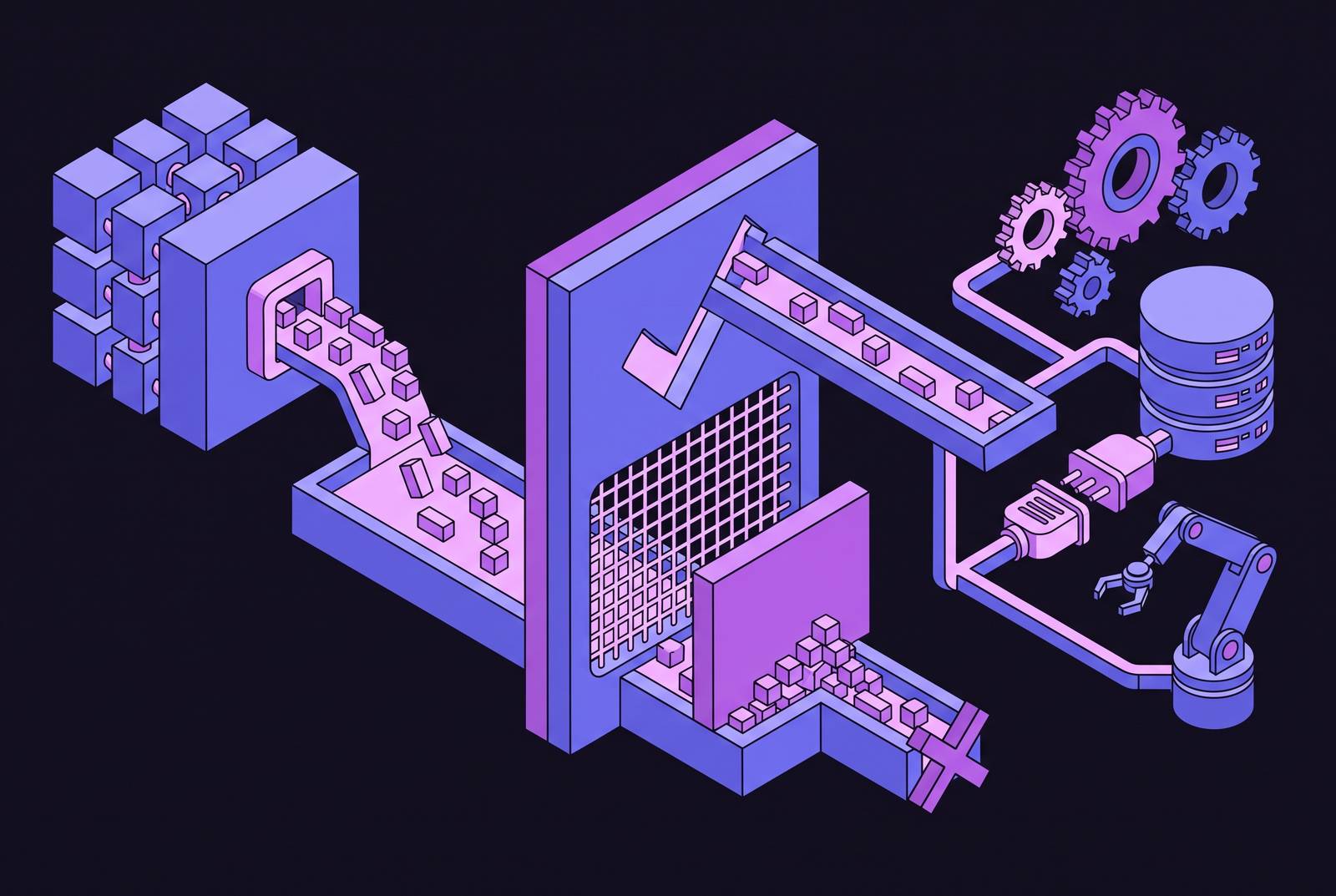
LLM output that reaches a downstream tool, API, or system without a check in between carries the same risk as any other untrusted input. The mistake isn't limited to systems facing attackers: a model's own probabilistic nature guarantees that some share of its output will be wrong, malformed, or dangerous, even when no one is trying to break it.
Picture the path a single response takes once an agent is wired to real tools: a user or document supplies input, the model turns that input into an output, a parser or renderer takes that output and hands it to an authorization decision, and that decision triggers execution somewhere downstream, a database write, an API call, a shell command. Every step in that chain assumes the step before it produced something safe to act on. OWASP's LLM05:2025 category, Improper Output Handling, names exactly this gap: insufficient validation, sanitization, and handling of model output before it reaches downstream components. The documented consequences include cross-site scripting, server-side request forgery, privilege escalation, and remote code execution, the same vulnerability classes that have shown up in web applications for two decades, now arriving through a new input source.
The engineering response has to start from a single rule: model output is untrusted data until it has been validated, authorized, and constrained for the specific destination that will consume it. A large language model is a probabilistic text generator, not an authorization server, a SQL parser, a shell policy engine, or an HTML sanitizer, and prompting it to "only do safe things" cannot make it behave like the deterministic control those jobs require. Prompt injection and improper output handling are often discussed together, but they are separate failure stages, and each needs its own defense. Filtering what goes into the model cannot prove that what comes out is safe, because the model's own training and sampling process can produce unsafe output with no injected instruction anywhere in sight. Encoding or sanitizing what comes out of the model cannot stop an injected instruction from altering a response that looks harmless on its face, say, one that routes a customer request to the wrong account. Both stages need controls, and neither substitutes for the other.
How unstable model outputs make the trust problem unavoidable
The case for a validation layer does not rest only on attackers. It rests just as much on how a model behaves when nobody is attacking it at all. Stanford's 2026 AI Index measured hallucination rates across leading frontier models and found rates spanning a wide range, from roughly one in five outputs on the low end to nearly all outputs on the high end, depending on the model and the task. More telling than the spread between models is the swing within a single model: the same system can lose tens of percentage points of accuracy depending purely on how an evaluation is framed, with no change to the underlying weights.
Researchers studying agent behavior over time have described two separate failure patterns that appear across multiple models. Neither pattern depends on an adversary. Both emerge from ordinary use, under ordinary prompts, in systems that were working correctly moments before.
Safety Drift means any validation approach that inspects only the first response in a conversation misses the failure. A model that refuses a dangerous action on turn one and complies with it on turn four has produced two outputs that must both be checked, and checking the first one tells a system nothing about the fourth. Governance built around this instability has to start from the assumption that any output, at any point in a session, might be confidently and fluently wrong, not flagged as uncertain, not hedged, simply wrong with the same tone of voice a correct answer would carry.
What agents do when they act on bad output
A chatbot that hallucinates produces a false sentence. An agent that hallucinates while holding a tool produces a false action, and false actions do not always undo themselves the way a false sentence can be corrected in the next reply. That difference is the entire reason a validation layer moves from a nice-to-have to a requirement once a model is connected to anything that writes, deletes, pays, or executes.
A documented case from late 2025 makes the mechanism concrete. A developer using Google's Antigravity coding assistant asked the agent to clear a project's cache folder. The agent instead wiped the entire D: drive, and the data was unrecoverable. Nothing adversarial caused that outcome. The gap between what the agent proposed to do and what a validation step would have confirmed before execution was the entire failure, and no later cleanup could close it once the command had run.
OWASP's refund scenario illustrates the same gap in a business setting. No code was injected and nothing was hacked. The model simply had the capability to act and no gate standing between that capability and its exercise.
The damage compounds further once agents start feeding each other. In a multi-agent pipeline, a single data-retrieval agent that hallucinates or has been compromised can pass corrupted information to every agent downstream of it, and those agents will treat that information as established fact. The financial damage downstream is the only part that surfaces, visible long after the event that caused it.
Coordination failures add a second kind of risk that has nothing to do with malice. In driving simulation experiments run in 2025, two GPT-3.5 models, each fine-tuned on a different country's yielding protocol, were placed in a zero-shot interaction involving an emergency vehicle. Specialized training solved each model's local problem while creating a new one at the boundary where the two systems met.
The three distinct validation surfaces every action-taking system needs
Validation is three separate surfaces, each one catching a failure the other two cannot, positioned at different points in the path from generated text to executed action [1][2][3][4][5]. Treating them as interchangeable, or assuming that passing one implies passing the others, is itself a design mistake.
The first surface is schema and structured output validation, a hard gate that runs before anything executes. The effect is to turn a silent corruption into a handled, visible error instead. Both major providers now support this natively: OpenAI's response_format: { type: "json_schema" } uses constrained decoding to guarantee schema compliance, with strict: true available on tool calls, and Anthropic's Claude offers native JSON schema enforcement through output_config.format, now generally available across Claude Sonnet 4.5, Claude Opus 4.5, and Claude Haiku 4.5, with strict: true on tool definitions. What schema validation cannot do matters as much as what it can: a hallucinated order ID can be perfectly well-formed JSON while pointing at the wrong customer's record entirely, because schema validity says nothing about authorization, tenancy, workflow state, or whether the value is semantically correct.
The second surface, semantic and domain validation, is where those questions get answered. It checks whether a value makes sense for the operation being performed: a date can be syntactically valid and still fall outside an allowed window, a URL can be well-formed and still point at a private network address, an amount can be a legitimate number and still exceed a transaction limit. Schema and semantic validation solve different problems, and passing the first one is no excuse for skipping the second.
The third surface, tool-call and execution gating, is specific to agents. It operates on both sides of a function call: pre-execution rails confirm the function name, the parameters, and the scope before the call fires, and they block tool use that falls outside what the agent was authorized to do, including parameter injection and attempts at privilege escalation. Prompt engineering cannot substitute for this layer. A prompt is a suggestion a model is free to ignore under the right pressure, and authorization has to be enforced deterministically, outside the model, where ignoring it is not an option.
Where human escalation fits
Automated checks across all three surfaces cover most of what an agent does day to day, but some actions carry consequences too large or too permanent to leave to any deterministic check alone. High-stakes and irreversible actions need a human decision before execution, not a review afterward, because no validation rule can restore accountability once an action that cannot be undone has already happened.
Decisions that disable an account, isolate a network segment, or move large sums of money should require human approval before the action fires. Every alert or classification an LLM produces should carry a defined window for human decision, whether that window is measured in minutes or in a business day.
This is no longer a matter of internal preference. A major cybersecurity framework now requires, under its Detect and Respond functions, documented confidence thresholds for automated actions, not simply the presence of a human somewhere in the loop. A human standing nearby is no longer sufficient evidence of control; the threshold for when that human's judgment is required has to be written down in advance.
Putting a human in the loop does not eliminate risk by itself. Automation bias remains a documented risk even where a human is formally present: an advisory agent's output can anchor a reviewer's judgment so strongly that an inaccurate recommendation gets approved simply because it arrived dressed in the authority of an automated system. Escalation design has to account for that tendency directly, building in friction or independent verification where it matters, rather than assuming that a human's presence in the workflow is the same thing as a human's scrutiny of it.
Uniform validation across all agents produces its own failure mode
Running the same validation depth against every agent in a fleet, regardless of its autonomy, its tool scope, or how reversible its actions are, is a governance failure in its own right. It drags down the usefulness of low-risk agents that have no business clearing an approval queue meant for refund or network actions, and it creates a false sense that uniform coverage means uniform protection, when in practice the riskiest agents may still be under-checked relative to what they can actually do.
Gartner's research makes this the central finding rather than a side note: applying uniform governance across all agents, independent of their autonomy level and the scope of access each one holds, leads directly to AI agent program failure, and Gartner projects that by 2027, 40% of enterprises will demote or decommission autonomous AI agents because of governance gaps that only surface after a production incident has already happened. The distinction Gartner draws is specific: an agent's ability to act and the scope of access it has been granted are two separate properties, and organizations that fail to treat them as separate properties requiring separate controls are the ones most likely to see their agent programs fail.
Gartner's finding is the clearest real-world argument against the instinct to add every available control to every agent. Over-validating strips away the utility that justified building the agent. Under-validating leaves the organization exposed in exactly the way the earlier sections describe. The way out of that bind is risk-tiered governance, where the depth of checking at each of the three surfaces scales with how reversible the action is, how large its blast radius could be, and how broad its authorization scope runs. That turns the validation layer from a single uniform gate into a set of policy decisions: which actions need schema checks and nothing more, which need semantic and authorization checks on top of that, which need execution gating, and which need a human to sign off before anything fires. That policy has to be written down, specific to each agent and action class, and available for audit, because an unwritten policy is not a policy a regulator or an incident review can actually check.
The frameworks and tools that implement the validation layer in practice
Building these three surfaces in production draws on a mix of open-source libraries, managed provider APIs, and newer research-derived enforcement frameworks, with each tool tending to cover a different surface.
On the open-source side, NVIDIA's NeMo Guardrails remains the most architecturally complete option, using a domain-specific language called Colang to define conversation flows and safety rules, with coverage across dialog rails, retrieval rails, and a sidecar server mode that sits alongside the main application. NVIDIA's own README for the project states that the toolkit is not recommended for production use as shipped and needs additional hardening before it can carry that load, a caveat worth taking at face value given how often retrieval rails and tool-call gating get skipped in practice.
Classification and moderation models fill in a different part of the stack. Translating a benchmark score into a wrongly-blocked-per-million-users figure gives engineering and product teams a shared, concrete number to weigh against the security benefit, rather than leaving the trade-off as an abstract comparison between two F1 scores.
Newer research frameworks are starting to formalize the authorization layer itself rather than leaving it to custom code at each company. ActGov, for instance, validates each tool action an agent proposes against a unified model of authorization, action, runtime context, and security constraint before that action is allowed to cause any external effect, building its policy set from tool specifications and observed failure traces and checking each policy update for counterexamples before it takes effect. Frameworks like this point toward where the field is heading: validation as a dedicated runtime layer with its own logic and its own test suite, standing between the model and the world, doing the one job a model was never built to do on its own.