Multi-Agent Orchestration With Shared Context Stores
Shared context stores are the load-bearing component that makes or breaks multi-agent coordination.
Multi-agent orchestration is a coordination problem, not a model-selection problem, and most teams building agent systems have that backwards. They spend the budget picking a model and leave the coordination layer, the thing that actually determines whether the system works, to chance. That's why so many deployments stall out after the pilot.
The adoption numbers make the gap obvious. Most enterprises say they've adopted AI agents, but only a small fraction, somewhere around one in ten, run them in production. Gartner expects task-specific agents to show up in 40% of enterprise applications by the end of 2026, up from under 5% a year earlier. That's a steep climb on a short timeline. The same firm has also cautioned that unclear value, rising costs, and weak governance remain persistent risks for agentic AI deployments. Put those two forecasts side by side and the message is plain: the industry is racing to ship agent systems faster than it's learning how to make them coordinate.
Whether multi-agent systems are worth building isn't really the question anymore. The market and the roadmap already answered it. What follows covers what makes them work once a team has committed, and it focuses on the shared context store, the component every orchestration pattern depends on and the one that determines whether agents hand off work cleanly or quietly corrupt each other's outputs.
Multi-agent orchestration means coordinating multiple autonomous agents so they work toward a shared goal, under a layer that governs how they interact. It is not a handful of agents running in parallel and hoping their outputs line up, though that's precisely what a lot of early deployments amount to. The distinction sounds obvious once stated, but it's the one most teams blur the first time they wire agents together.
The orchestration layer makes three decisions continuously: which agent runs next, what context that agent receives, and what happens when something fails. Strip out that layer, and the individual agents can still perform well in isolation. Collectively, though, they produce incoherent results, and costs pile up that nobody's tracking closely.
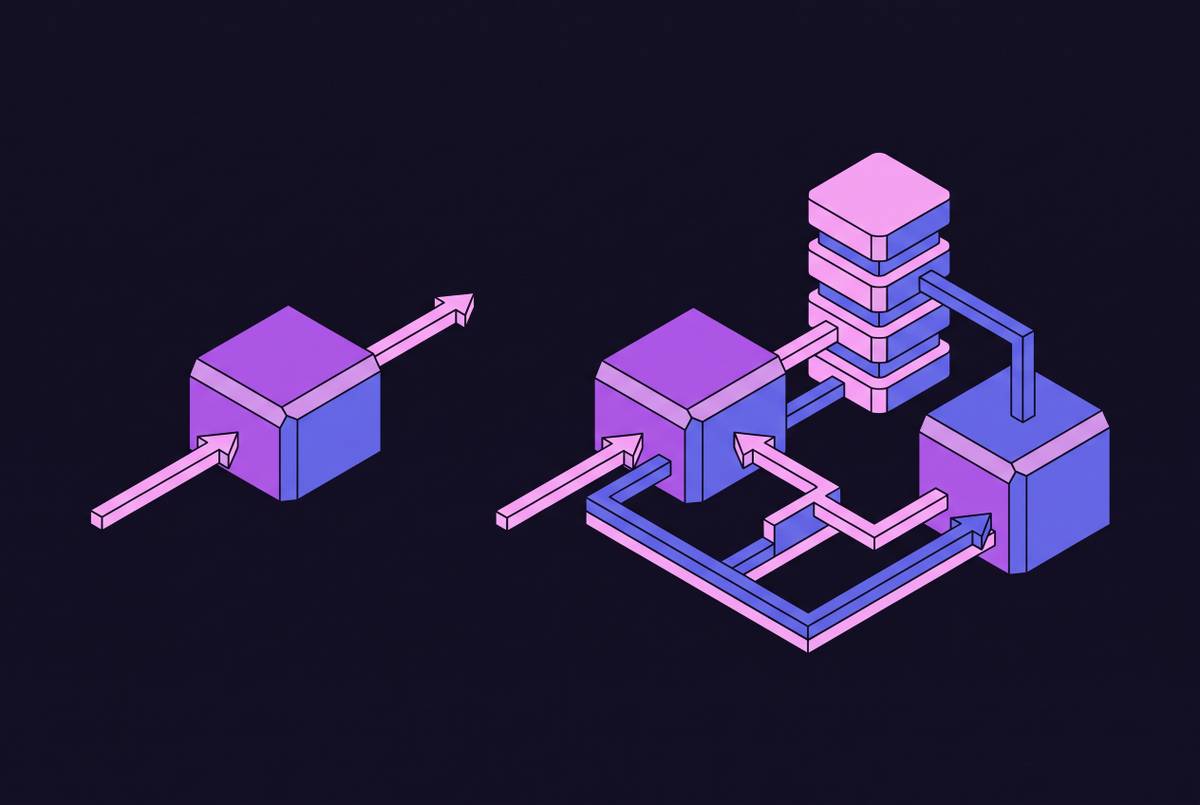
A financial reporting workflow makes the case concrete. One agent queries transaction data. A second applies regulatory classification to those transactions. A third checks the output against policy. A fourth formats the result for delivery. Each step depends on the one before it, each uses different tools, and none of them can do their job without knowing what the prior agent decided. That chain is the difference between orchestration and a single general-purpose agent working through a task list on its own: the single-agent case needs no coordination layer, because there's nothing to coordinate, while the four-agent chain needs one, because a break anywhere in that sequence propagates forward.
Gartner's 2025 research on agentic AI found that close to half of surveyed vendors named orchestration as their primary point of differentiation. The vendors closest to this problem no longer think the contest is about model quality. They think it's about who can make agents work together reliably, and the data backs them up.
The four runtime components an orchestration layer must have
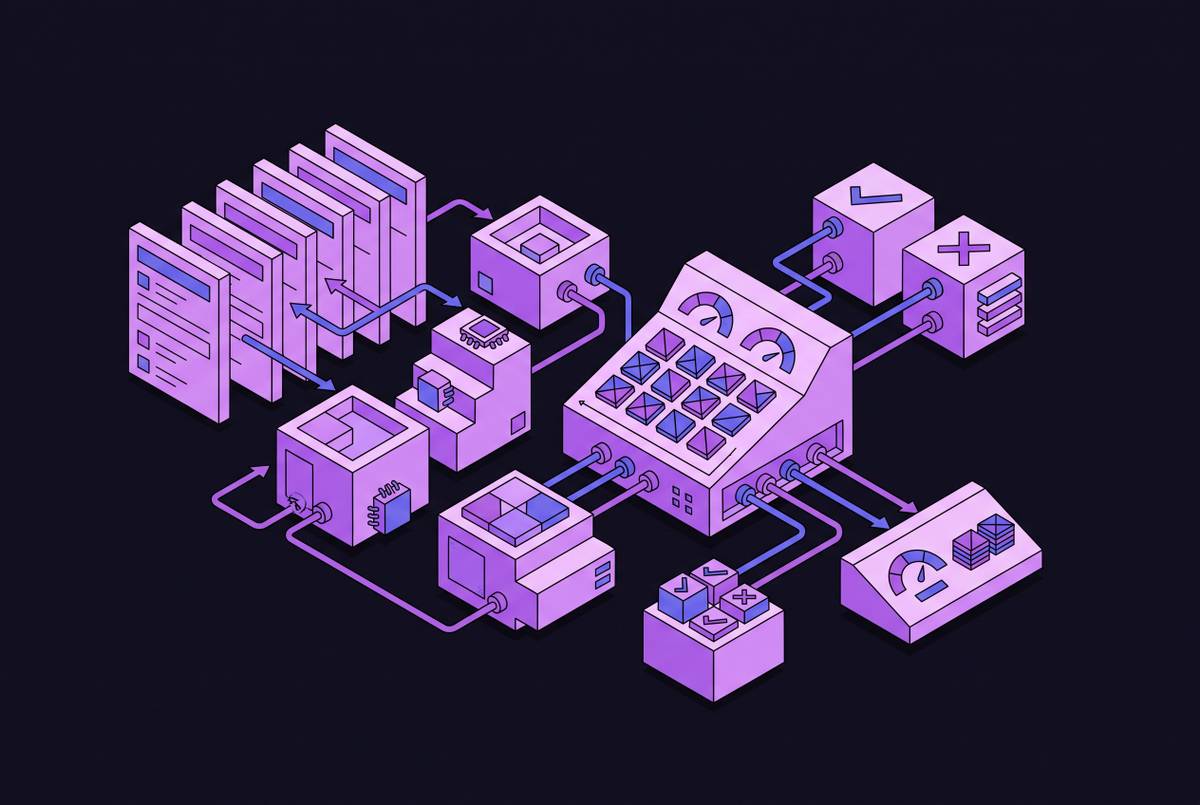
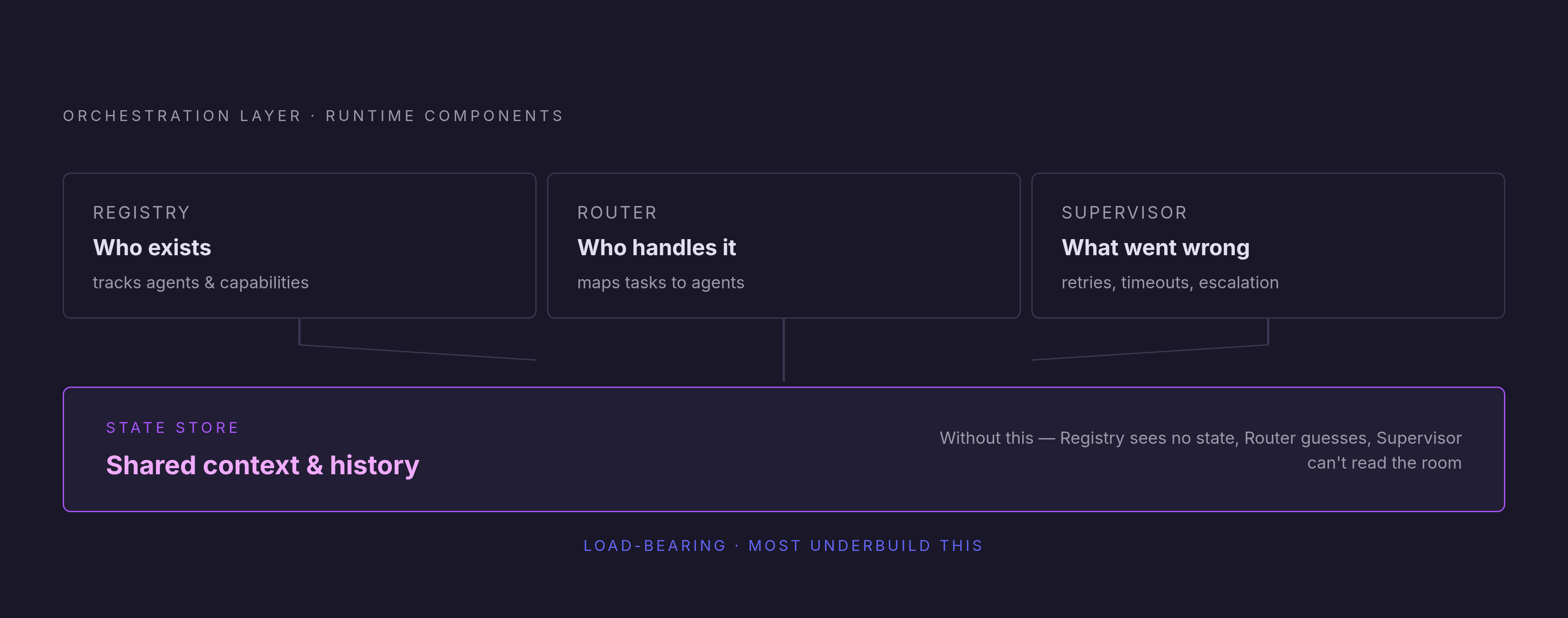
Strip an orchestration layer down to its essentials and four components show up every time. A registry tracks which agents exist and what each one can do, a router maps an incoming task to the right agent or sequence of agents, a state store holds shared context and conversation history, and a supervisor watches for timeouts, manages retries, and escalates when something goes wrong.
Of those four, the state store is the one that makes the other three mean anything, and it's the one teams underbuild most often. A registry without shared state just tells you who's available. A router without shared state has to guess at context every time it makes a decision. A supervisor without shared state can't tell whether a timeout happened because an agent hung or because it was waiting on information that never arrived.
At runtime, a well-built system does four things in sequence. It breaks a high-level objective into subtasks. It routes those subtasks to specialist agents operating within a narrow, defined scope of tools and permissions, because narrow scoping is what keeps failure modes manageable when something does go wrong. It carries context and state across the entire execution chain, so a user doesn't have to re-explain themselves at every step and later agents can act on what earlier ones learned. And it defines, in advance, what happens when a sub-agent times out, needs a retry, or needs to escalate to a human.
Skip that last piece, and one of two things happens: the whole system stalls waiting on a sub-agent that never responds, or the orchestrator plows ahead with incomplete information and produces an answer that looks plausible but is wrong.
Persistence itself introduces a failure mode single-agent systems never have to worry about. A wrong fact written into shared state at step two doesn't stay contained to step two. It gets read by step three, acted on by step four, and by the time a human notices something's off, the error has touched every downstream decision. Debugging that is a materially harder problem than debugging a single agent that gave one bad answer to one question.
Three orchestration patterns and where context consistency breaks down in each
Three patterns dominate how teams structure multi-agent systems, and each fails differently once context handling breaks down.
Supervisor/worker is the simplest: a central supervisor decomposes the task, routes pieces to workers, and synthesizes their outputs. Workers never talk to each other directly. That makes debugging easier, since every coordination decision passes through one node, and it's a natural fit for sequential chains with clear routing logic. But centralizing everything creates the risk you'd expect: the supervisor becomes a bottleneck, and its context state becomes a single point of failure. If the supervisor's understanding of the task is wrong or stale, every worker inherits that error.
Peer-to-peer flips the structure. Agents talk directly to each other, any agent can delegate or request input from a peer, and no central coordinator can bring the whole workflow down by failing. That resilience comes at a cost. Without a shared context layer capturing every interaction, reconstructing the full reasoning chain after the fact becomes very difficult, and for anything with audit or compliance requirements, that's a serious problem. This is exactly why observability infrastructure is load-bearing in peer-to-peer designs, not a nice-to-have wrapped around the edges.
Hierarchical orchestration sits between the two. A top-level supervisor delegates to mid-level supervisors, each managing its own set of specialist workers, and the structure forms a tree: authority and context flow down, results flow back up. This pattern suits complex, multi-domain problems and large agent networks well, because it mirrors how organizations already divide labor. The risk here is subtler and more dangerous than in the other two patterns, though. Say two mid-level supervisors disagree on what counts as a "qualified lead" or a "compliant transaction." That inconsistency doesn't stay local: it cascades into every worker beneath the mismatched supervisor, and nothing in the structure catches it before it reaches the output.
All three patterns, in the end, leave the same question open: where does the system store what it knows, and who's allowed to read it? Answer that badly, and the pattern chosen stops mattering much at all.
What a shared context store is and what it actually holds
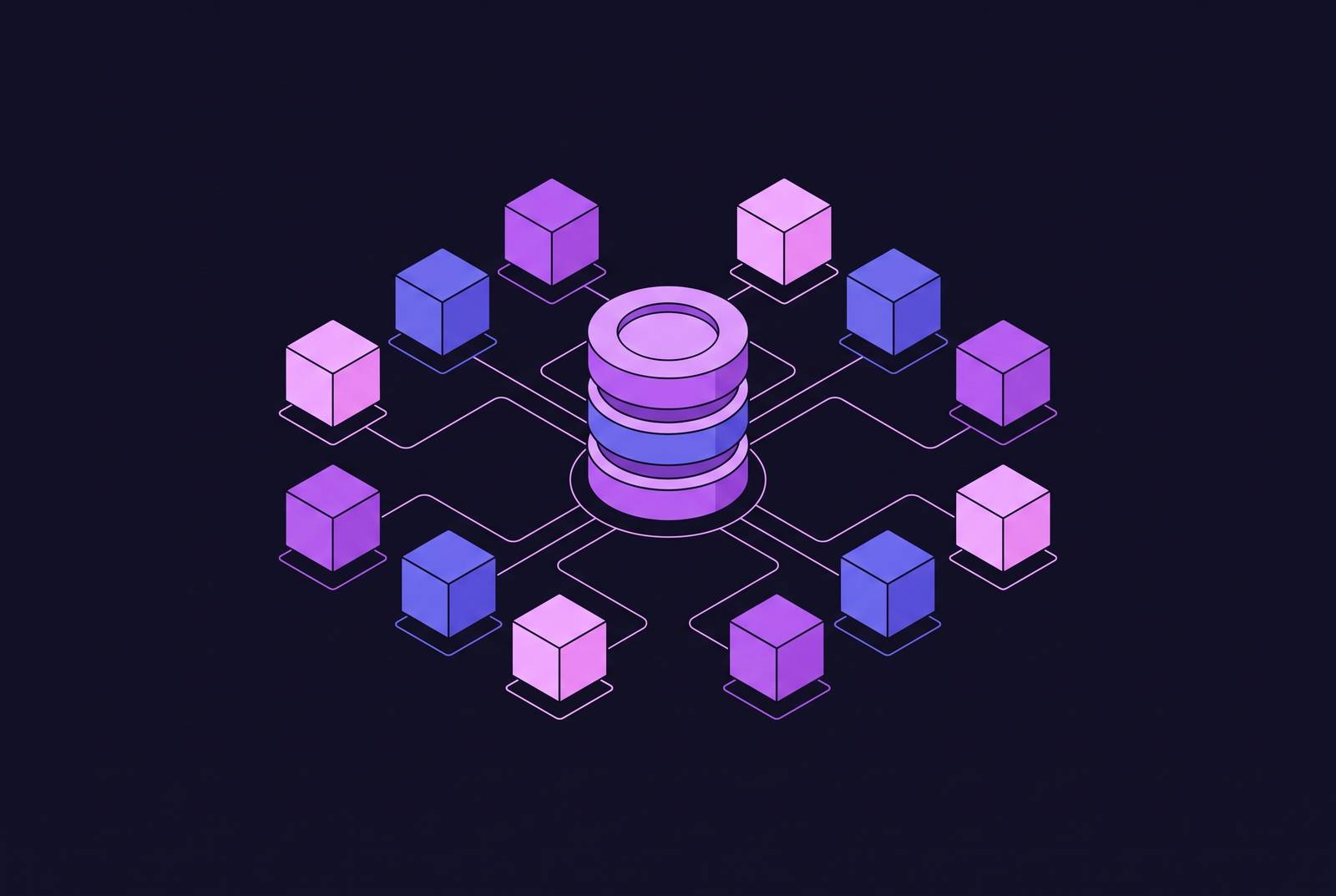
In the original Model Context Protocol implementation, agents, models, and servers are stateless. None of them has access to a global memory of what's happened elsewhere in the workflow. A shared context store is the infrastructure built to close that gap, and treating it as optional is the mistake underlying most of the failure modes described above.
Researchers have started naming this component explicitly. A paper proposing a Shared Context Store, submitted in January 2026, showed the approach reducing redundant work and improving knowledge transfer between agents, with statistically significant results on the TravelPlanner and REALM-Bench benchmarks. That's a meaningful result: it means the store isn't just a convenience for developers debugging a workflow, but a factor that changes what the system is capable of producing in the first place.
What actually lives in the store, in practical terms, breaks into four categories. There is the conversation history across every agent turn, the intermediate outputs passed from one agent to the next, the shared facts and classifications and decisions made earlier in the chain, and a registry of what each agent in the system can and can't do.
Teams building these stores today lean on different substrates depending on what they need to retrieve. Vector databases handle semantic search across prior agent outputs, useful when an agent needs to find "something like this" rather than an exact match. Graph databases map relationships between entities and decisions, which matters when the workflow depends on understanding how one classification connects to another. Document stores hold the unstructured material that doesn't fit cleanly into either.
IBM has published results from its watsonx implementations showing centralized data access through watsonx.data producing AI outputs 40% more accurate than conventional retrieval-augmented generation setups. That's the clearest quantified case in the current literature for why centralizing context beats leaving it scattered across isolated agent memories, and it should settle the argument for teams still debating whether a shared store is worth the build cost.
Centralization isn't free, though. High-performance scenarios needing sub-second responses can't afford to hit a centralized store on every single decision; the round trip costs too much time. The workaround teams are converging on is distributed shared memory with periodic synchronization: agents hold local state for speed, and the shared store gets updated on a schedule that keeps everything consistent without forcing every micro-decision through a central bottleneck.
The memory problem that no framework has solved for you
Orchestration, as a mechanical problem, is the easy part. As the 2026 literature on the AI agents stack makes clear, deciding which agent runs next is a routing problem, and routing problems are well understood by now. Deciding what an agent system should remember, what it should forget, and how to keep old context from contaminating a new answer, is not well understood, and no framework on the market ships an answer to that out of the box. Pretending otherwise is how teams end up debugging a polluted context store six months into production.
Three decisions fall on the team building the system, and none of them has a default that works for every case. What gets written to the store in the first place matters most: not every agent output deserves to persist, and writing everything indiscriminately just builds a polluted store that later agents have to wade through. What gets dropped, and on what schedule, matters just as much, because stale context isn't harmless clutter; it actively skews decisions that depend on it being current. Who gets read and write access carries real weight too: an agent with broader access than its job requires introduces the same cascading-inconsistency risk that a misaligned mid-level supervisor does in a hierarchical system.
A paper on the TEA protocol, part of the AgentOrchestra project submitted in June 2025, points at a related structural gap: neither of the two dominant agent protocols in use today standardizes any way to keep execution context consistent and versioned across the tools and environments an agent touches. Lifecycle management and context management are, in the current state of the art, fragmented rather than solved.
AgentOrchestra's TEA protocol approach to unifying tools, environments, and agents scored 89.04% on the GAIA Test set, among the strongest results reported for that benchmark. That result is the strongest evidence available that rigorous context and lifecycle management deserves the same engineering attention teams already give to code.
The failure mode that recurs across every source examining this problem runs the same way each time. A wrong fact gets written into shared state early in a workflow. Every agent downstream treats that fact as ground truth, because nothing in the system flags it as suspect. The error stays invisible until someone reviews the final output, and by then it's touched every step in between. Frameworks available today handle state persistence in varied ways, with different defaults and tradeoffs. Choosing among them is, whether teams realize it going in or not, choosing a memory model as much as a coordination model.
How MCP, A2A, and emerging protocols define what context can travel and how
The Model Context Protocol, released by Anthropic in November 2024, gave the industry its first widely adopted open standard for connecting AI models to external tools and data sources. It's been described, reasonably, as something like a USB-C port for AI applications: one interface, many devices on either end.
OpenAI's decision to adopt MCP in March 2025 mattered more than a single vendor's technical choice. It moved MCP from an Anthropic-specific standard to something closer to an industry default. By March 2026, the MCP ecosystem had grown to more than 200 server implementations, with major platforms including GitHub, Slack, Google Drive, PostgreSQL, Notion, Jira, and Salesforce all providing MCP servers of their own.
Google released the Agent-to-Agent protocol in April 2025, built to complement MCP rather than compete with it. MCP governs how an agent talks to a tool. A2A governs how one agent talks to another. A2A defines five elements structuring that communication. The Agent Card handles discovery of what an agent can do, the Task is a defined unit of work, the Message is a single turn of communication, the Part is a unit of content within a message, and the Artifact is the tangible thing an agent produces as a deliverable.
In December 2025, Anthropic, Block, and OpenAI formed the Agentic AI Foundation under the Linux Foundation, contributing MCP, Block's Goose, and OpenAI's AGENTS.md into a shared governance structure. That's a strong signal the industry expects these protocols to keep converging rather than splinter into competing standards.
Even so, meaningful gaps remain, and the TEA protocol paper is specific about what they are. Neither A2A nor MCP handles lifecycle management or versioning for execution context. Neither supports self-evolution at the protocol level, meaning prompts and resources still get maintained externally by humans rather than refined automatically from how the system actually performs. And environments, the runtime conditions an agent operates in, aren't treated as first-class managed components in either protocol; they're pushed down to whatever application-specific runtime happens to be running underneath.
Four protocols are active in this space right now, namely MCP, A2A, the Agent Communication Protocol, and the Agent Network Protocol. That's not a settled landscape. Teams choosing infrastructure today are choosing into a standard that's still moving, and researchers have flagged real security exposure in MCP specifically, including risks around malicious code execution, remote access control, and credential theft tied to weak authentication and authorization. Context that flows through a shared store inherits all of that exposure, since the store becomes a single place where a compromise touches everything downstream.
What breaks at scale when the context store is missing or poorly designed
Consider a supervisor agent that receives a financial query and routes it, in parallel, to a Finance specialist and a Compliance specialist. Each agent works from its own local state. Neither knows what the other is doing. The supervisor gets two answers back, built on two different definitions of the same underlying fact, and has no way to reconcile them into a coherent response.
That's a common case. It's the routine, structural failure mode that shows up whenever agents operate from separate, unsynchronized memory, and it's the single weak point where orchestration breaks down at scale, whatever the vendor pitch decks say about latency or model quality. It's a coordination failure with a specific, identifiable cause: nobody decided where the shared truth lives.
Peer-to-peer systems suffer a version of this that shows up specifically in audits. Without a shared context layer recording every interaction between agents, there's no way to reconstruct after the fact why the system did what it did, which makes compliance and audit requirements effectively impossible to satisfy.
Hierarchical systems suffer a version that grows with depth. Inconsistency introduced at one mid-level supervisor doesn't stay contained to that branch of the tree; it propagates into every worker beneath it. The deeper the hierarchy, the larger the surface area for that kind of error to spread before anyone catches it.
A quieter structural weakness shapes this outcome too. Existing frameworks generally lack any standardized way to represent an agent's role, competencies, and objectives, so systems struggle to systematically capture what each agent is actually for, and interoperability between frameworks suffers as a result. A shared context store can't compensate for information the framework never captured in the first place.
Most companies plan to deploy agentic AI within the next two years. Only a small minority report having a mature governance model for how those agents operate, and that gap is a substantive risk that compliance footnotes fail to capture. It's an orchestration architecture problem, and it gets worse, not better, as agent networks scale up.
Design principles for a shared context store that holds up in production
Write intentionally, not automatically. Decide in advance which agent outputs are worth persisting to the shared store, and treat the store as a curated record rather than a running log of everything that happened. A store that captures everything indiscriminately is functionally as unreliable as one that captures too little, because agents downstream can't tell signal from noise either way.
Version execution context. This is the core move behind the TEA protocol's approach, and it's the difference between a store a team can debug and one it can't. Traceable, versioned context means a bad output can be traced back to the exact piece of state that caused it, instead of guessed at.
Scope read and write access by role. The same logic that keeps agent tool permissions narrow and manageable applies just as directly to context access. A sub-agent handling one piece of a workflow doesn't need to read the entire store, and giving it that access anyway just widens the blast radius when something goes wrong.
Plan the local-versus-centralized tradeoff on purpose. Agents needing sub-second responses should hold local state and synchronize with the shared store on a schedule, rather than hitting a central store on every decision. That synchronization schedule is a real architectural decision someone has to own, not a default setting left untouched.
Build observability into the store itself, not as an afterthought wrapped around it after launch. This matters most in peer-to-peer systems, where every agent-to-agent interaction needs to be captured somewhere, or there's no reconstructing what happened later.
Treat context hygiene as governance, not just engineering. Stale, contradictory, or high-risk context sitting in a shared store is a governance failure before it's a technical one, and Gartner's projection that over 40% of agentic AI projects could be canceled by 2027 reflects, in no small part, projects that never treated it that way. Pattern choice reinforces this: hierarchical orchestration with localized tool ownership, the approach AgentOrchestra takes, narrows what each layer of the hierarchy has to hold in context at all, turning one hard global coordination problem into a sequence of smaller, bounded routing decisions.
What this means for teams building AI visibility and content operations at scale
AI chatbot referral traffic reached 1.1 billion visits in June 2025, up 357% year over year. The surfaces where brands now need visibility are themselves multi-agent systems: a query gets decomposed, routed to specialists, and synthesized into an answer, using the same architecture this piece has spent its length describing. Content built to reach those surfaces increasingly moves through orchestrated agent workflows of its own, whether a team designed for that explicitly or backed into it by stitching together tools without much of a plan.
That makes the shared context store more than an infrastructure detail for engineering teams to sort out quietly in the background. It's the mechanism deciding whether a content operation's outputs stay consistent across every agent that touches them, from research to drafting to compliance review to publishing, or whether they quietly drift apart the way the Finance and Compliance agents did earlier in this piece.
A large majority of brands still aren't tracking how they perform in AI search at all. That gap will only get more expensive as the systems answering customer questions become more agentic, more orchestrated, and more dependent on context that has to travel cleanly between specialized components to produce an answer worth trusting.