Metadata Filtering to Improve Retrieval Precision
Filter metadata before vector search runs to prevent irrelevant results.
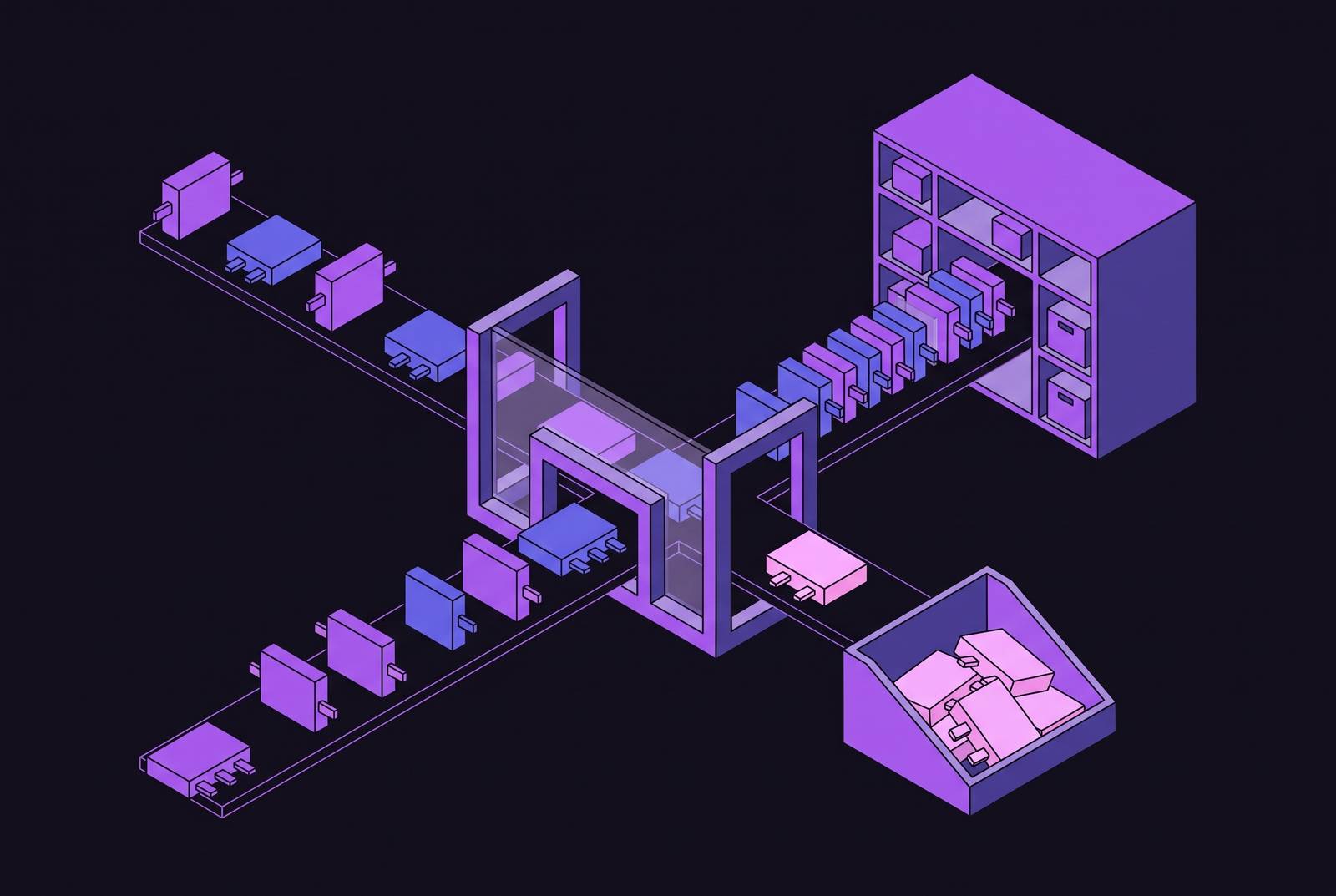
Metadata filtering improves retrieval precision by narrowing the pool of candidate vectors before similarity search ever runs, and getting this right is what separates a RAG pipeline that holds up under real traffic from one that quietly degrades. A pipeline that retrieves purely on vector similarity looks fine in a demo, where the corpus is small and clean, and starts breaking the moment the corpus grows large, repetitive, or sensitive to time. The failure doesn't announce itself loudly at first. It appears in noisy chunks pulled into context, answers that sound plausible but rest on the wrong year or the wrong company, tokens spent processing irrelevant text, and users who stop trusting the system after enough wrong answers slip through.
Take a query like "What risks does the company identify related to supply chain disruptions?" run against a stack of SEC 10-K filings AMAQA: A Metadata-based QA Dataset for RAG Systems. The embedding model is doing what it was built to do. It's doing what it was built to do, matching meaning.
Metadata filtering fixes this not by making the embedding model smarter, but by shrinking the set of vectors it's even allowed to consider before it starts comparing anything. One industry write-up from August 2026 describes it as a low-lift, high-impact technique, since it filters and boosts results using structured tags and doesn't require any heavy computation AMAQA: A Metadata-based QA Dataset for RAG Systems. That framing matters for anyone approaching this for the first time: this is a technique available to teams without custom infrastructure. It's closer to adding a WHERE clause to a query you were already going to run AMAQA: A Metadata-based QA Dataset for RAG Systems.
Filterable metadata and how it attaches to chunks
Metadata, in this context, means structured facts about a document or a chunk that sit outside its actual content: the date it was written, where it came from, what topic it covers, who wrote it, what type of document it is, which section it sits in, what form type it follows, which company or fiscal year it belongs to. Unstructured.io groups the most commonly filtered attributes into three categories: date, which enables chronological filtering; source, which supports credibility and provenance checks; and topic, which scopes results to the right subject area.
Preprocessing produces this structural layer: during preprocessing, systems often extract fields like parent_id and category_depth, which preserve where a chunk sat inside the original document's hierarchy, so retrieval doesn't strip a paragraph from its context. During preprocessing, systems often extract fields like parent_id and category_depth, which preserve where a chunk sat inside the original document's hierarchy, so retrieval doesn't strip a paragraph of its surrounding context. Chunking and metadata design aren't separate decisions, either. A chunking strategy that respects section headings and logical document breaks gives you metadata anchors for free, whereas chopping text into arbitrary token windows throws that structure away.
A recent ECIR 2026 study built a benchmark using 25 SEC 10-K filings from five U.S. technology companies: Apple, Alphabet, Adobe, Oracle, and Nvidia. The filings were split into 350-token chunks with 50-token overlap, producing 4,490 retrieval units in total, each tagged with company, year, section, and form type ECIR 2026 AMAQA: A Metadata-based QA Dataset for RAG Systems. That's a fairly lean schema. Compare it to AMAQA, a benchmark that carries up to 11 distinct metadata fields per subset, including timestamps, chat names, emotional tone, and toxicity indicators ECIR 2026 AMAQA: A Metadata-based QA Dataset for RAG Systems. The spread between those two examples says something useful on its own: metadata schema design isn't one-size-fits-all, it scales with how messy and how conversational the underlying corpus actually is AMAQA: A Metadata-based QA Dataset for RAG Systems. Newer indexing work confirms this is becoming standard practice rather than a niche optimization, with systems routinely folding in keywords, timestamps, and document categories specifically to support filtered retrieval later on ECIR 2026.
The three filtering strategies: pre-filter, post-filter, and integrated approaches
Once metadata is attached to a chunk, the next decision, and arguably the more consequential one, is when in the pipeline that metadata actually gets applied. This is probably the most contested architectural question in the field right now, and a 2026 paper on filtered approximate nearest neighbor search benchmarked all three major approaches across production-style vector database systems to try to settle it.
Pre-filtering applies the filter before vector search even starts, so only eligible vectors are ever compared against the query. It guarantees full recall inside whatever subset survives the filter, and it avoids the wasted work of fetching candidates you'll throw away later. A filtered subset often has no purpose-built index of its own, which forces the system into a brute-force scan that gets slower as the number of distinct metadata values grows AMAQA: A Metadata-based QA Dataset for RAG Systems. This isn't a hypothetical concern for pgvector users specifically. HNSW indexes from pgvector 0.5.0 onward can apply WHERE clauses while walking the index itself, which produces real speed gains, but IVFFlat indexes still scan the entire index before any filter gets applied at all, so the choice of index type ends up mattering as much as the choice to filter in the first place AMAQA: A Metadata-based QA Dataset for RAG Systems. A RAG Fusion deployment described in one paper makes a related point: pre-filtering constrains the searchable subset but does not alter scoring or ranking logic, a distinction that matters when debugging a pipeline that's filtering correctly but still ranking poorly AMAQA: A Metadata-based QA Dataset for RAG Systems.
Post-filtering flips the order. Vector search runs first against the full index, typically HNSW, and the metadata filter gets applied afterward to whatever top-K candidates came back. This depends on over-fetching, since there's no way to know in advance what fraction of the nearest neighbors will actually satisfy the filter. The failure mode here is quiet and easy to miss in testing: the true nearest neighbor that does satisfy the filter might sit just past the edge of the candidate set the system pulled, and it never gets a chance to appear in the results. A pre-filter can fragment the search space into pieces too small to search efficiently; a post-filter can throw away the right answer before it's ever seen. Neither failure is obviously worse; they're just different.
A third category tries to avoid choosing between those two failure modes by fusing metadata directly into the index structure itself AMAQA: A Metadata-based QA Dataset for RAG Systems. Approaches like ACORN and UNG couple metadata tightly with the graph or index at build time. The 2026 systems study found that these fusion methods tend to lack schema-agnosticism: they don't generalize well across general-purpose vector databases, and architectural choices, like Milvus's algorithmic adaptability or pgvector's query optimizer cost models, often matter more in practice than which underlying algorithm looks best on paper AMAQA: A Metadata-based QA Dataset for RAG Systems. A separate paper from March 2026, describing what it calls Fiber-Navigable Search, frames the problem geometrically: filtering a proximity graph produces what the authors call a "fiber," a subgraph whose connectivity can look nothing like the full graph it came from, and they propose a two-phase search that mixes full-graph exploration with filtered-neighbor descent to compensate AMAQA: A Metadata-based QA Dataset for RAG Systems. No single strategy wins. Which one makes sense depends on how big the corpus is, how selective the filter tends to be, how much concurrent traffic the system needs to handle, and which index type is already in place.
Measured impact on retrieval precision: what the benchmarks show
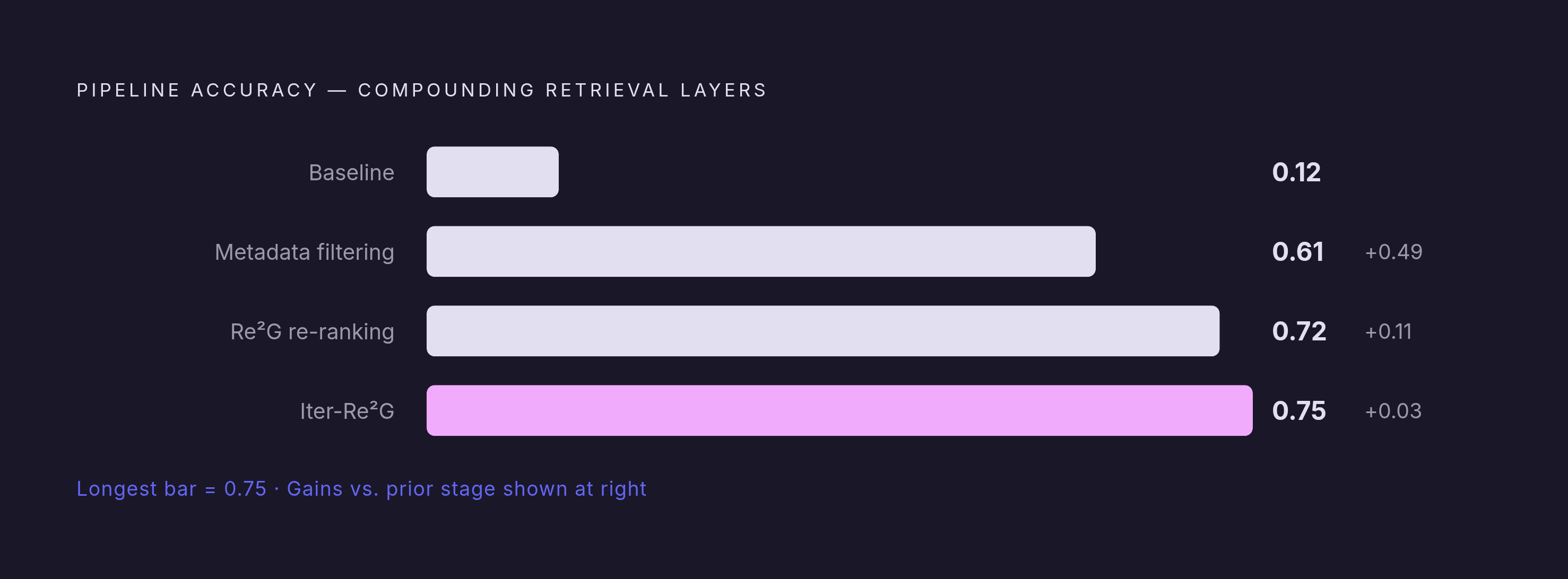
The clearest number in this entire field comes from AMAQA: accuracy jumps from 0.12 to 0.61 once metadata gets used in retrieval AMAQA: A Metadata-based QA Dataset for RAG Systems ECIR 2026. That improvement moves a system from mostly wrong to mostly right, not a rounding-error gain.
Layering re-ranking on top pushes the number further. The Re²G approach lifts accuracy to 0.72, and an iterative version called Iter-Re²G, which expands context across multiple passes, reaches 0.75 The Moonlight. A pipeline that skips filtering and leans entirely on re-ranking is trying to fix a candidate pool that was never good to begin with.
AMAQA's model-level breakdown backs up the idea that this isn't an artifact of one particular LLM's quirks. Metadata pushed GPT-4o's accuracy from 0.5 to 0.86, and it pushed open-source models from 0.27 to 0.76 AMAQA: A Metadata-based QA Dataset for RAG Systems ECIR 2026. Both jumped by roughly the same margin, which suggests the gain comes from giving the model better material to work with, not from any one model being unusually good at compensating for bad retrieval.
Outside controlled benchmarks, a production RAG pipeline tracked in a May 2026 Towards Data Science piece using RAGAS scoring found Context Precision rising from 0.71 to 0.79 once metadata pre-filtering kept stale and irrelevant documents out of the candidate pool before re-ranking even started AMAQA: A Metadata-based QA Dataset for RAG Systems. Still, it's a real gain, measured against a live system rather than a curated dataset. A separate practitioner report claims a hybrid setup combining keyword search, semantic search, metadata filtering, and re-ranking together produced a precision boost of up to 30% alongside a nearly 40% drop in irrelevant results, though that comes from a practitioner blog with unverified methodology and should be read as directional rather than definitive AI Discovery Digest AMAQA: A Metadata-based QA Dataset for RAG Systems SRAG: RAG with Structured Data Improves Vector Retrieval.
The SRAG paper adds a more rigorous data point from the structured-metadata side AI Discovery Digest AMAQA: A Metadata-based QA Dataset for RAG Systems SRAG: RAG with Structured Data Improves Vector Retrieval. Adding topics, sentiments, semantic tags, and knowledge graph triples to both queries and chunks improved LLM-as-judge answer scores by 30%, with a p-value of 2e-13 using GPT-5 as the judge, and the gains were largest specifically on comparative, analytical, and predictive questions AI Discovery Digest AMAQA: A Metadata-based QA Dataset for RAG Systems SRAG: RAG with Structured Data Improves Vector Retrieval. That last detail matters. Metadata doesn't help uniformly across every kind of question, it helps most exactly where plain similarity search is weakest: questions that require comparing across documents rather than matching a single passage.
Where the benchmarks stop and production complexity begins
AMAQA's authors are upfront about the dataset's limits, and those limits are worth taking seriously rather than treating the 0.12-to-0.61 jump as a universal law AMAQA: A Metadata-based QA Dataset for RAG Systems ECIR 2026. The metadata schema tested tops out at 11 fields per subset, which is not a large or deeply nested schema by production standards, and the paper doesn't test what happens once schemas get more complex or fields start interacting with each other AMAQA: A Metadata-based QA Dataset for RAG Systems. It also targets single-hop question answering only, cases where the answer sits inside a single retrieved source, while a lot of real-world queries require pulling from multiple documents and reasoning across them. And because it's the first benchmark built specifically around metadata integration, there's no prior body of comparable work to check these numbers against yet.
Vector database benchmarks in general tend to run under conditions a vendor controls: clean data, predictable query patterns, no concurrent load fighting for the same resources. One engineering account from March 2026, via Actian, described a system running several hundred million vectors with many concurrent clients each hitting different metadata subsets, where filtering itself became the bottleneck AMAQA: A Metadata-based QA Dataset for RAG Systems. The database was spending more time resolving which vectors matched the filter than it was spending computing similarity distances AMAQA: A Metadata-based QA Dataset for RAG Systems.
None of this is an argument against filtering. It's an argument for treating benchmark numbers as a starting hypothesis rather than a guarantee, and for load-testing any filtering architecture under the concurrency and cardinality conditions it'll actually face before committing to it in production. Moving data between the vector graph and relational metadata store can cause P99 latency to jump by an order of magnitude as CPU waits for disk I/O, dev.to/actiandev reports.
Self-querying retrieval: letting an LLM extract filters from natural language
None of the filtering strategies discussed so far solve a more basic problem: users don't write metadata filters, they write plain sentences. A pipeline that requires users to write explicit metadata filters, rather than natural language, has a UX ceiling.
Self-querying retrieval closes that gap by putting an LLM in front of the vector store as a translator. The model reads the natural language query, figures out which parts of it correspond to structured fields, and generates the filter itself. Asking for "science fiction movies released after 2000 with a rating above 8" causes the model to pull out genre, year, and rating as distinct fields and build a structured query around them without anyone writing filter syntax by hand. LangChain's implementation of this, the SelfQueryRetriever, wraps around the vector store and hands the LLM a list of AttributeInfo objects, each one naming a field, describing what it means, and specifying its type, so the model knows what it's allowed to extract before it ever sees a user's question. AMAQA's own experiments used Mistral-nemo for exactly this kind of structured query generation, which is a sign this pattern has already moved from concept to active research use rather than staying theoretical ECIR 2026.
A pipeline built around FinanceBench pushes the idea further ECIR 2026. An LLM receives the user's query alongside summaries of the available documents, picks out which filenames are actually relevant, rewrites the query with sharper keywords and concepts, and only then runs hybrid search, restricted strictly to the files it selected. Combining file filtering, query rewriting, and metadata-enriched chunks this way produced a meaningful improvement over both baseline RAG and other advanced retrieval setups tested in the same study ECIR 2026.
LLMs can hallucinate filter values, such as a wrong date or a category name that doesn't exist in the schema at all AMAQA: A Metadata-based QA Dataset for RAG Systems ECIR 2026. Extracted filters need validation against a known list of allowed values before they're ever executed, not after. Second, filter syntax doesn't travel between vector stores. Pinecone works with simple equality operators, Chroma supports more complex logical combinations, and Milvus handles range queries differently again, so a filter written for one store can fail outright, or worse, silently return the wrong results, in another. Third, the quality of the schema description handed to the LLM directly gates how well it extracts filters. A vague or incomplete description of what a field means produces unreliable extraction, no matter how capable the underlying model is. The writer must cover all three critical failure modes.
Enriching chunks with generated metadata before indexing
Self-querying assumes the metadata you need already exists somewhere in the document. Often it doesn't, and the more useful move is generating it. Metadata doesn't have to be extracted, it can be created by an LLM at indexing time and stored alongside the chunk it describes, effectively giving a document properties it never explicitly stated.
The SRAG approach, described in a 2026 paper from Anvai AI, applies this at both ends of the pipeline AMAQA: A Metadata-based QA Dataset for RAG Systems. It augments queries and chunks with topics, sentiments, query and chunk types like informational or quantitative, knowledge graph triples, and semantic tags. What's notable is what SRAG doesn't require: no change to the vector store's interface, no new retrieval architecture AI Discovery Digest AMAQA: A Metadata-based QA Dataset for RAG Systems SRAG: RAG with Structured Data Improves Vector Retrieval. Only the ingestion pipeline changes, which makes this a comparatively low-risk technique to adopt against an existing stack. The authors call this framing episodic-style retrieval, aiming for broader and more varied retrieval that catches contextually relevant chunks pure embedding similarity would walk right past. Consistent with the earlier benchmark numbers, the strongest gains appeared on comparative, analytical, and predictive questions, exactly the query types where matching on surface-level similarity tends to fall apart AI Discovery Digest AMAQA: A Metadata-based QA Dataset for RAG Systems SRAG: RAG with Structured Data Improves Vector Retrieval.
The FinanceBench pipeline mentioned earlier applies a version of the same idea, building "contextual chunks" enriched with metadata at indexing time and pairing them with a post-retrieval stage that runs both a cross-encoder and a metadata-aware re-ranker ECIR 2026. Generating metadata at indexing time adds compute and latency to ingestion, work that has to happen once per document rather than once per query. That's a front-loaded cost in exchange for better retrieval quality every time a query runs afterward, which is usually the right trade when a corpus gets queried far more often than it gets updated. One more requirement matters here and gets skipped too often: generated metadata needs to follow a controlled vocabulary. Free-text tags generated without constraints fragment at query time, since "supply chain risk" and "supply-chain disruption" end up as two different filter values instead of one AMAQA: A Metadata-based QA Dataset for RAG Systems.
Combining metadata filtering with hybrid search and re-ranking into a coherent pipeline
Put together, the research points toward a layered pipeline rather than any single technique carrying the whole load. The first stage is a metadata pre-filter that shrinks the candidate space down to only the documents that could possibly be relevant, filtering by date, source, company, or section before anything resembling a similarity comparison happens. That stage does the coarse work cheaply, the way a librarian pulling books from the right shelf saves time before anyone starts reading table of contents pages.
From there, hybrid search, combining keyword matching with semantic vector search, runs against the reduced candidate pool, and a re-ranking stage scores what comes back before anything reaches the LLM. Each stage in that sequence exists because the stage before it isn't sufficient alone: metadata filtering removes what's obviously wrong, hybrid search catches what pure vector similarity misses, and re-ranking sharpens the ordering of what's left. The benchmark numbers across AMAQA, SRAG, and the production RAGAS study all point the same direction: filtering constrains the space, ranking refines what's inside it, and skipping either stage leaves real precision on the table Towards Data Science AMAQA: A Metadata-based QA Dataset for RAG Systems AI Discovery Digest SRAG: RAG with Structured Data Improves Vector Retrieval. Building this well takes some patience with the plumbing, testing filter cardinality, checking index type against filter strategy, watching tail latency under real concurrency, but the reward for that patience is a retrieval system that gives the right answer instead of merely a plausible one.