Reranking Models and Their Impact on RAG Answer Quality
Placing better documents at the top of the context window dramatically lifts RAG answer quality.

Retrieval-augmented generation runs on a two-stage architecture, and the trouble almost always starts in the first stage. That's the trade the system makes on purpose: speed now, precision later. Squeezing a document down into a single vector or a bag of terms throws away the fine-grained relationships between what the query is actually asking and what the document actually says.
Redis documented a concrete failure mode, published 2026-07-29, in which a product manager's RAG assistant cites a deprecated API version; the trace shows the correct docs page sitting at position 23 in a 50-chunk retrieval, meaning retrieval succeeded but ranking didn't. Retrieval had, technically, done its job. The right page was in there. Ranking hadn't done its job, and the model reached for whatever looked closest to the top instead of what was actually correct.
There's a compounding wrinkle here that makes rank order matter even more than it might first appear to. Large language models don't treat every position in a context window equally: attention tends to degrade for content buried in the middle, a pattern sometimes called context rot. So it isn't enough for the right chunk to be somewhere in the prompt. Where it sits changes whether the model actually uses it.
None of this is a rare failure mode dressed up to sound alarming. A 2026 guide to RAG systems found that naive pipelines fail at retrieval 40% of the time, which makes poor ranking the default condition of unreranked RAG, not some unlucky exception. It's a precision problem, not a recall problem. The right document is typically already sitting somewhere in that candidate pool of 50 or 100. It just isn't surfaced anywhere near the top, where an LLM with limited attention and a limited context budget can actually make use of it.
Why relevance scoring alone isn't enough for a reranker
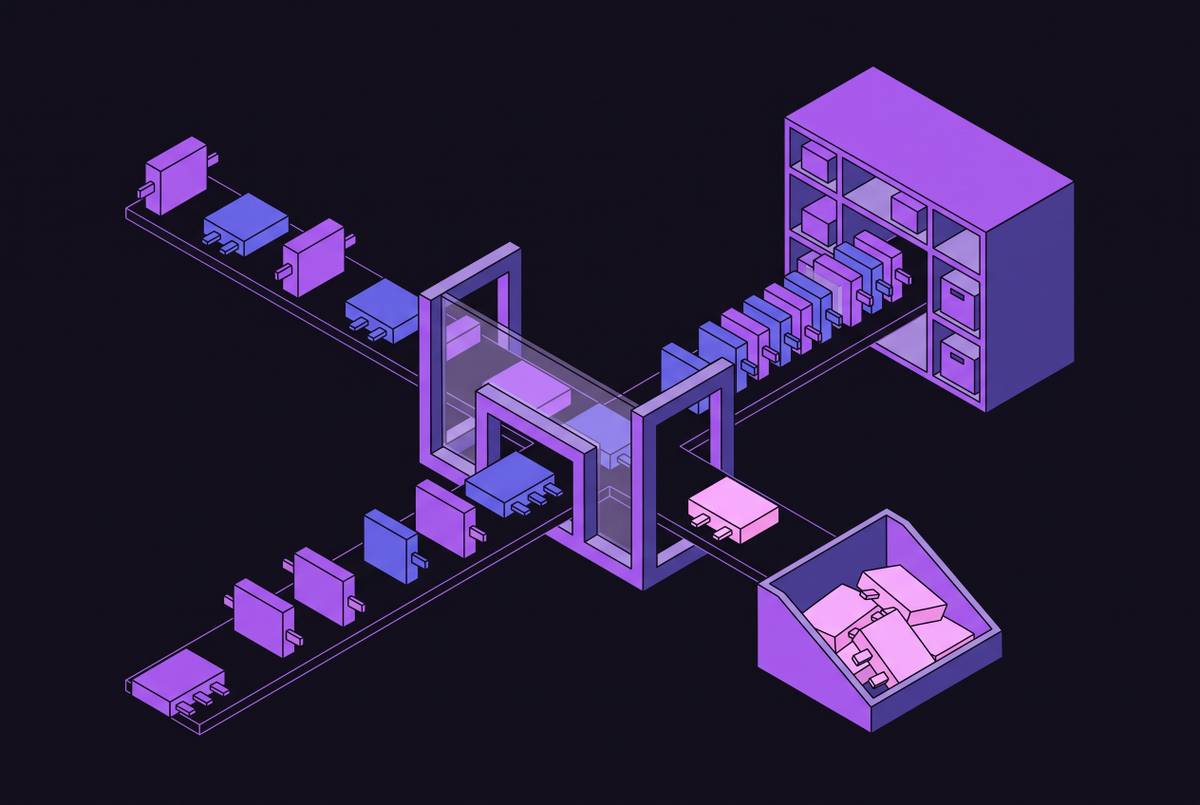
A reranker is the second stage that exists to fix exactly that. It's slower and more expensive per item than the first-stage retriever, but it only has to work through the shortlist, not the whole corpus, and its job is to rescore and reorder those candidates so the most useful chunks are at the top of the prompt.
The standard description of what a reranker does, measuring query-document relevance, holds up fine as a first pass but starts to crack under scrutiny. Recent work on confidence-aware reranking (the CAR paper, from Song and colleagues) makes the case directly: a passage can be lexically and semantically on-topic for a query and still muddy the water for the model generating the answer, introducing ambiguity, distraction, or evidence that quietly conflicts with a better source lower in the ranking. The reverse holds too. A passage ranked lower by conventional relevance scoring can be exactly the one that steadies the model's answer once it's actually in the context.
CAR's proposal, in short, is that ranking ought to measure a passage's marginal contribution to the generator's answer stability, weighted more heavily than its surface-level closeness to the query CAR: Query-Guided Confidence-Aware Reranking. Tested against BM25-centered retrieval, the correction layer produced a 5.53% mean relative gain in NDCG@5, and on a fixed NQ-answerable benchmark it added 0.43 points of token-level F1 CAR: Query-Guided Confidence-Aware Reranking.
The practical takeaway shapes both which architecture a team picks and how they evaluate it. A reranker's real function isn't just sorting a list into a nicer order. It's filtering what the model is actually allowed to reason from, since a reranker that's technically accurate on relevance scoring can still hand the generator a confusing mix of evidence.
The three reranker architectures and their trade-offs
Cross-encoders remain the workhorse of production reranking. The query and a single candidate document are fed into the same transformer together, so every query token can attend to every document token, and the model outputs one relevance score per pair. That joint attention is precisely why cross-encoders catch distinctions that vector-based bi-encoders miss, but scoring one pair at a time is expensive, which caps how large a candidate pool they can realistically handle. Most mainstream production rerankers today, including offerings from Cohere, Voyage, BAAI's bge-reranker, and Mixedbread's mxbai-rerank, sit in this family because they share the classic encoder backbone, though some 2026 entrants like mxbai-rerank-v2 and bge-reranker-v2-gemma swap it for a decoder-style language model instead. On the speed side, Redis measured the compact cross-encoder/ms-marco-MiniLM-L6-v2 at 74.30 nDCG@10 on TREC DL19 while processing 1,800 documents per second, which is a useful reminder that a small, well-tuned cross-encoder can be fast enough for most production loads.
Late-interaction models, the ColBERT family being the reference point, split the difference. Query and document get encoded separately into sets of per-token vectors, the document side can be precomputed offline, and relevance at query time comes from a cheap max-similarity operation across those vectors rather than a full joint pass. That architecture lands in the middle: faster at inference than a cross-encoder, but with richer matching than a plain bi-encoder that collapses everything into one vector. The cost appears in storage instead of compute, since keeping one vector per token across an entire collection adds up; later versions use residual compression to shrink that footprint, but it's still a real line item for infrastructure planning. Where it earns its keep is in tight latency budgets on self-hosted deployments and in long documents, where matching happens at the token level rather than the document level.
Listwise LLM rerankers take a different shape entirely. The whole shortlist gets passed into a generative model at once, and it returns a ranked ordering directly, with no separate per-pair scoring step, which opens the door to genuine cross-document reasoning. These models can also work zero-shot, through prompting alone, without the training or fine-tuning a cross-encoder needs. Zero-shot LLM rerankers tend to underperform fine-tuned rerankers once they hit out-of-domain data, so treating a large general-purpose model as an automatic upgrade is a mistake. And because the model reads candidates in whatever order they arrive in the prompt, the original retrieval rank can bleed into the supposedly fresh ranking unless candidates get shuffled first. The Qwen3-Reranker family, at 0.6B, 4B, and 8B parameters, sidesteps some of this by scoring through yes/no token probabilities rather than generating an ordering outright, which blurs the line between the cross-encoder and LLM camps.
None of these three is simply better than the others LLM-based reranking study. Each is a different trade among accuracy, latency, and infrastructure cost, and which one fits depends on the volume of queries, the latency budget, and how specialized the domain is, questions the next two sections work through directly.
Reranking's impact on results (what the evidence shows)
The clearest evidence comes from domain-specific work rather than general benchmarks. A financial-domain study found that reranking lifted answer correctness at scores of 8 or higher to 49.0%, compared with 33.5% without reranking, a jump of 15.5 percentage points Financial-domain RAG study. That's a major change. An assistant with reranking is right about half the time on high-confidence answers, while one without it is wrong more often than not.
Legal and contract retrieval offers a slightly different picture of the same underlying dynamic. Recall tends to be high in this domain, with the correct clause usually somewhere in the top 50 candidates, but precision is low, because similarly worded clauses cluster together and confuse relevance scoring. In that setting, reranker uplift on NDCG@5 in the range of 0.10 to 0.15 is common, which is exactly the pattern reranking is built to fix: it doesn't need to find the needle, it needs to move the needle that's already there to the top.
Fine-tuning adds another layer of gain on top of architecture choice. A study comparing a fine-tuned LLaMA 3 8B reranker against a cross-encoder baseline on domain-specific QA found gains of 14% in answer relevancy, 16% in context precision, 19% in answer similarity, and 21% in answer correctness LLM-based reranking study. Those are substantial numbers, though they come with a cost attached: fine-tuning an 8B model is a real investment of engineering time and compute LLM-based reranking study.
A related side effect, reported by a reranking vendor (ZeroEntropy) and best treated as directional rather than gospel, is that companies using hybrid retrieval plus reranking report a 25% reduction in token usage, as better-ranked context tends to shorten prompts ZeroEntropy reranker guide. Less noise in the context window means the model needs fewer tokens to say the same correct thing.
None of this should read as an unconditional endorsement. The ARAGOG study found that Cohere's reranker showed no notable advantage over naive RAG in some configurations, and the reason lines up with everything above: reranking helps when recall is high and precision is the bottleneck, but it can't rescue a document that never made it into the candidate pool in the first place. So the diagnostic question that has to come first is whether the failure is a recall problem or a precision problem, because reranking only answers one of those. Per flotorch.ai's RAG landscape report, re-ranking has overtaken LLM size as the dominant performance accelerator, with high-quality top-3/top-5 passages correlating strongly with grounded answers.
The accuracy-latency-cost triangle that governs every deployment decision
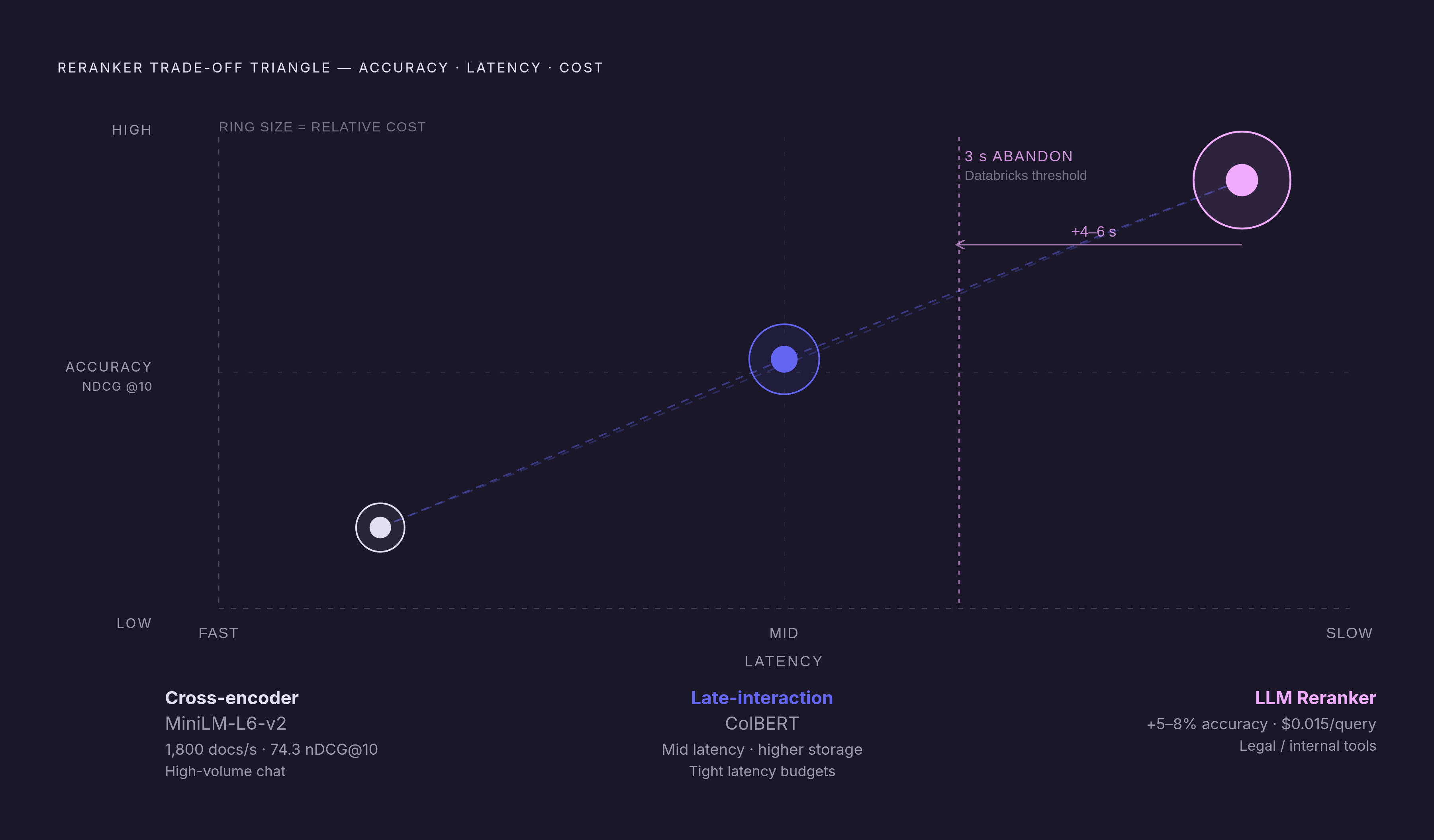
Every reranking decision eventually comes down to three competing constraints, and improving one tends to cost something on the other two. Databricks benchmarks show modern cross-encoders reranking 50 documents in 1.5 seconds, which functions as the practical baseline most production teams build around ZeroEntropy reranker guide.
LLM-based reranking sits at the far end of the accuracy-latency trade, and the arithmetic on cost gets stark quickly. Using a model like Haiku 4.5, priced around $1 per million input tokens and $5 per million output tokens, reranking 50 candidates of 250 tokens each costs roughly $0.015 per query. At a sustained rate of one query per second, that's $54 an hour; push the same workload to 100 queries per second and it becomes $5,400 an hour. That math rules LLM reranking out for high-volume consumer chat immediately, but it's entirely reasonable for legal search or internal knowledge tools where queries arrive at human pace rather than at scale.
Latency tells the same story from a different angle. LLM rerankers can add 5 to 8% accuracy over listwise approaches, but they also tack on 4 to 6 seconds of latency compared with a cross-encoder, and Databricks testing found users start abandoning searches after about 3 seconds ZeroEntropy reranker guide. So for anything synchronous and user-facing, that accuracy gain arrives too late to matter to the person waiting on it ZeroEntropy reranker guide.
Production teams working at real volume have found a workaround: stacking cross-encoder rerankers on top of multi-query expansion compounds latency, but two-stage micro-reranking (a small model first, with a large model only touching its top-k) cuts P99 latency in half for a small hit to recall.
The decision, stripped down, comes to three buckets LLM-based reranking study. Latency-sensitive, high-volume systems want a compact cross-encoder or a self-hosted late-interaction model. Accuracy-sensitive, low-volume systems can afford an LLM-based reranker or a larger fine-tuned cross-encoder LLM-based reranking study. Managed API latency for Voyage Rerank-2.5 and Cohere Rerank 3.5 averages 595–603ms including network round-trip, acceptable for RAG chat and knowledge-base assistants but too slow for autocomplete or sub-300ms end-to-end targets. As a candidate pool sizing heuristic, 50 documents suffice for LLM chat where speed matters, while 100–200 are recommended for comprehensive search where thoroughness outweighs latency. The decision frame given to the reader is: latency-sensitive/high-volume calls for a compact cross-encoder or late-interaction self-hosted model; accuracy-sensitive/low-volume calls for an LLM-based reranker or fine-tuned larger cross-encoder; and cost-sensitive/embedded calls for an open-weight 0.6B–4B class model.
The current reranker landscape: managed APIs and open-weight models worth knowing
The company behind it, ZeroEntropy, was acquired by Notion, and its models have since been open-sourced under Apache 2.0; products are fully supported until September 4th, 2026, which is a detail anyone building on it needs to plan around rather than assume will quietly continue Agentset Reranker Leaderboard.
Cohere's Rerank 4 sits second on that same leaderboard at an ELO of 1629, split into a Pro tier built for accuracy and a Fast tier built for latency, with broad language coverage that makes it a commonly recommended managed option. Voyage's Rerank-2.5 makes sense as a bundled choice for teams already using Voyage embeddings, and Voyage's own benchmarks claim a 7.94% improvement over Cohere's Rerank v3.5, though that figure is vendor-reported and worth treating with some skepticism until independently verified.
The open-weight side has gotten genuinely competitive. Alibaba's Qwen3-Reranker family, at 0.6B, 4B, and 8B parameters, ships under Apache 2.0, supports over 100 languages, and handles a 32k context length. The 4B version posts published scores of 69.76 on MTEB-R, 75.94 on CMTEB-R, 72.74 on MMTEB-R, 69.97 on MLDR, and 81.20 on MTEB-Code, using that yes/no token-probability scoring method rather than generating a ranked list outright. BAAI's BGE Reranker v2-m3, also Apache 2.0, is a cross-encoder that's well established in production pipelines and commonly recommended for self-hosting. Mixedbread's mxbai-rerank-large-v2 offers both a self-hosted and a managed path under the same permissive license. And ColBERTv2 remains the reference point for tight latency budgets and for token-level relevance on long documents, since its late-interaction design precomputes document vectors and delivers the lowest query-time latency among the open options.
One pattern cuts across all of it: the 0.6B class of open models has gotten competitive enough to match rerankers several times its size on many benchmarks, so bigger isn't automatically better, and self-hosting a compact model can undercut API spend substantially at scale. Before self-hosting anything, though, the license needs a direct check. Apache 2.0, covering Qwen3, BGE, and mxbai, is permissive; CC-BY-NC-4.0, covering Jina, is not. Jina Reranker v2 (base multilingual) is available via the Jina API, though its CC-BY-NC-4.0 license is not permissive for commercial self-hosting without a separate agreement.
Reranking beyond relevance: generator-aware and confidence-based approaches
Standard rerankers, whatever their architecture, are still optimizing for the same target: how closely a passage matches the query. That leaves a gap, because a passage can clear that bar and still hand the generator evidence that's ambiguous or that quietly contradicts a better source elsewhere in the context.
The CAR framework, developed by Song and colleagues at Dalian University of Technology, approaches the problem from the generator's side instead of the retriever's. It's a training-free correction layer that scores each candidate by the change it produces in the stability of the generator's sampled answers: a passage that makes the model's answers more consistent across samples moves up, and one that scatters the answers into disagreement moves down.
Two design choices make CAR practical to actually deploy. It needs no task-specific training and no access to model internals like logits or hidden states, working instead entirely from a black-box model's generated text. And rather than throwing out the existing ranking, it converts confidence changes into loose precedence rules and returns the closest feasible ranking to the original, measured by minimum Kendall distance, so it only overrides prior pairwise preferences when the generator-side evidence actually justifies it. That makes it a correction layer sitting on top of an existing reranker.
The direction this points toward, ranking by what actually helps the generator rather than by surface relevance alone, looks like where production RAG tuning is headed next, particularly in domains like legal, medical, and financial work where a wrong answer carries real cost.
Sources
- CAR: Query-Guided Confidence-Aware Reranking for Retrieval-Augmented Generation
- Top Reranking Models to Boost RAG Accuracy in 2026
- RAG Systems: The Complete Zero-to-Hero Guide (2026 Edition) | by Basukori | Medium
- Ultimate Guide to Choosing the Best Reranking Model in 2026 — ZeroEntropy Blog
- Enhancing Financial Report Question-Answering: A Retrieval-Augmented Generation System with Reranking Analysis
- The 2026 RAG Performance Landscape: What Every Enterprise Leader Needs to Know
- Reranker API - Jina AI